Tuesday, May 16, 2023

College Campus Tour Red Flags: What to Look for on a Visit

Published October 8, 2019 | Last Updated May 9th, 2023 at 03:12 pm

A campus may appear to have it all. The best professors in a particular major. An active campus life. Beautifully designed dorms. Championship sports.

That is when you see a college on paper or online. But visit a campus, and an entirely different picture might emerge. Sometimes, what you and your student research about a campus may not be exactly what greets you once you land on campus for a visit.

In our Facebook group “Paying For College 101,” many parents have discussed “red flags,” or warning signs, to watch for when researching colleges and definitely make sure to know before your student calls a campus home.

Why visit? Taking a college campus tour of any school your student is interested in can be critical. While a tour seems like it would be a lovely experience, that is sometimes far from the case.

What Should I Expect on a Tour of a Campus?

You need to see the place with your eyes, get a feel for the place, and ask questions. It can be as simple as visiting a rural campus and deciding your child needs more city than country, or a more complicated situation like crime on campus.

Ask Questions from Those “In-the-Know”

You should get a comprehensive tour of the campus. Some colleges have student tour guides that may be inadequately trained to highlight the best a campus has to offer. Make sure you have a guide who knows the campus and covers all ground.

For example, your student may be very interested in astronomy, creative writing, or engineering. But the tour guide may focus on athletics and show sports facilities instead of classrooms. Many parents say that you can tell what a school values based on where guides take you on a tour.


Colleges often host fairs for specific majors. Major fairs should always have faculty in attendance who can answer questions about courses, extracurricular groups connected to areas of study, and internship and career opportunities.

Review the On-Campus Meal Plan

When you visit a campus, eat cafeteria meals like the ones your student will eat—not a special event, such as an open house, when the food is likely catered. Make sure the meal plan meets you and your student’s expectations. If the food is inedible, you could end up spending a lot of money on fast food for your student.

“Try the cafeteria food,” said parent Debbie D. “not Starbucks or Einstein’s or Chick-fil-A, but the school food your child will eat day after day after day. Pay attention to the hours of operation. Are the good places open on the weekends? My daughter’s school eateries weren’t. There were limited options on weekends, so for those staying, there wasn’t much to choose from, and she ended up going off campus.”

“If athletes will be there over winter break, ask what food options are available, if any,” she continued. “Nobody mentioned the school cafeteria closed for three weeks while winter sports athletes were required to be on campus. Apparently, this is supposed to be coordinated with athletics. So, my daughter had over three of eating bagged breakfast, frozen pizza, or make your own tacos. Also, ask how the regular hours of operation coincide with practices and games. If the program isn’t feeding you, will there be anything open late?”

Parent Elizabeth S. shared that food may simply need a little spicing up.  “Our take away is our kiddo will need a way to bring spices in to the dining hall.” 

Examine the Culture and Environment

Want to get real insight into campus life? Read the college newspaper. Why? Because most college newspapers are uncensored by faculty and administrators. The newspaper can expose various issues on the campus, including crime and students’ concerns.

For example, one parent in our Facebook group asked college administrators about alcohol problems on campus. The administrators and tour guides played down any problems. But she discovered that the student newspaper discussed the issue fairly and openly.

“Parents and students alike can learn so much from what is and what is not included in the student newspaper and/or other student publications,” Craig Meister, a college admissions consultant, says.” If none are available when on campus, try to find them online before or after your visit.”

Check out Potential Dorm Problems

If your student plans to live in a dorm, make sure you check it out thoroughly. While many campuses have spent millions of dollars to modernize their dorms, others have not. Some still look as if they are from the 1960s or 70s.

While that might seem quaint and even cool, it also can be deadly.


Many college dorms have mold problems, and often colleges do not want to be forthright about the problem. Ask for a tour, talk to students who live in the dorm, and research to see if any newspaper articles have been written about that particular campus.

Mold can cause serious illnesses, and even death, so make sure your student is safe.

Check to make sure the air conditioning and heating works sufficiently in dorms. Some colleges charge thousands of dollars for room and board but have yet to remodel them with modern luxuries.

Debbie D. encouraged parents to check out everything in the dorms, including “the furniture, the bathrooms, the lighting, and whether there is A/C or not.” After not being able to visit dorms due to COVID, she was surprised to find the dorms were like “going back in time, especially after seeing friends’ beautiful new dorms.”  

Assess the Infrastructure and Outdoor Space

Many parents advise walking all over the campus with a tour guide. Yes, this may sound exhausting, but look to see how the grounds are kept and if trash cans are overflowing. Is the college really proud of its campus? Are you seeing in real life what you saw online or in a brochure?

You also may assume—wrongly—that all campuses are wired with high-speed internet. That might not be the case, especially if your student plans on attending a rural college, one near mountains, or in an area of the state where internet connection is lacking.

What Else Should I Know About a College Campus?

Meister says parents can’t know enough about the college their student will attend. He also says you must ask about building security. Can anyone enter? How safe are the dorms? Are security procedures in place but not enforced? Who is responsible for security on campus—school police force, a city/town police force, a combination of both and/or a private security company?

 nother critical stop on any tour, Meister says, is a visit to the career services department. You’re sending your student to school to earn a degree and get a job. Ask if graduates have jobs six months or a year after graduating. Find out how those jobs are broking by major or industry.

Just as important are academic support services like tutoring.

“Parents should try to determine how accessible all these support services are on the campuses they visit,” Meister says.

Parents should also think about their students’ health.

“While no parent wants their children to have physical or mental health challenges while in college, it’s wise for parents to learn as much as possible while on campus about a college’s health services program(s),” Meister says. “Ask to see facilities or speak with those who administer the program in order to determine how accessible it will be for your student.”

Don’t forget to take plenty of notes and photos on each campus visit.

If you don’t get what you expect on a tour, talk to the college admissions office. If they don’t seem willing to assist, that college may not be the best fit for your student.


Monday, May 15, 2023

Science Data Camp - UGA

The Department of Statistics at the University of Georgia is partnering with Data Scientists at Wells Fargo to offer a Data Science & Artificial Intelligence Camp from July 17 - 21, 2023 (8am to 5pm). This will be held in-person at the University of Georgia Campus,Room 202 Caldwell Hall. About 30 high school students selected from across the Athens area will participate in this camp. This week-long hands-on learning program will be developed and taught by experienced faculty members from the Department of Statistics and Data Scientists from Wells Fargo with a passion for inspiring High School Students. The camp will be a fun and creative way to gain exposure to Data Science and Artificial Intelligence.
 

The program will introduce the students to:

  • Data Science & Python programming
  • Introduction to Linear models, Random numbers, Distributions
  • Advanced modeling & tuning (Neural Networks, Machine Learning, tree-based model)
  • Generative Adversarial Networks – Image manipulation
  • Module for Metaverse
  • Project (Data Collection, model initialization, optimization, assessment)
  • Final Hands-on Project & Presentation (Computer Vision & Detection: Rock-Paper-Scissors).
  • Optional Capstone Project

Details

Dates: July 17 to July 21, 2023
Camp Hours: 8:00 am to 5:00 pm
Venue: Room 202 Caldwell Hall, UGA (302 Herty Drive, Athens, GA 30602)
Parking: North Campus Parking Deck

Registration

Science Data Camp 


Jobs that Pay for College with Tuition Reimbursement

One of the newest work perks: full college tuition assistance. Find out who's offering it now.

Kathryn Knight Randolph

April 24, 2023

Jobs that Pay for College with Tuition ReimbursementWork for a company that will pay your college bills.
 
A few years ago, you would be lucky to find an employer that offered some sort of tuition assistance. The amount was usually capped at a few thousand dollars. Although any amount to pay for college is extremely helpful, it's nothing compared to what employers are offering now. In order to entice younger employees, major companies have begun offering massive college tuition benefits, like tuition reimbursement. Some of them are even paying for all college costs. If you are planning to work though college anyway, why not start your career with an employer that will make attending college less expensive for you? This is a great summer, part-time job idea! Additionally, you'll gain invaluable work experience that could mean a full-time position within the company – or elsewhere – after graduation.
Below, you'll find a few of your options that will help you pay for college. A few of these companies are offering these student-focused perks to part-time employees, too!

Companies that Cover All Tuition

In recent years, more and more companies have announced that they will begin covering 100% of college tuition for their employees. These are big name companies that likely have a retail center, office space, or distribution center near you.
Target Tuition Reimbursement: Target offers its employees free college tuition to 40+ colleges and universities across the United States. The retail giant will also cover course fees and textbooks. This perk is available for part-time employees. Amazon Tuition Reimbursement: Amazon isn't just covering college tuition for employees. It will also provide funding for course costs, textbooks, and fees. After 90 days of work, employees can have their semester pre-paid by Amazon. Walmart Tuition Assistance: Walmart employees can earn high school diplomas, college degrees, skilled trades, and professional certificates at no cost. The company will cover all costs for select online programs from universities like, The University of Arizona, University of Denver, and Purdue University. This perk is available for part-time employees.

Companies that Provide Tuition Reimbursement

Although the below companies don't cover the entirety of college costs, they still provide significant tuition assistance for their employees. Typically, you can claim tuition assistance for each year that you are in school; however, tuition assistance is oftentimes capped with a lifetime maximum amount. Below are just a few of the companies that are likely located around you with tuition benefits. Home Depot Tuition Reimbursement: At Home Depot, tuition assistance is a family affair. Full-time salary employees can receive up to $5,000 a year, full-time hourly employees $3,000, and part-time hourly up to $ 1,500 per year. UPS Tuition Reimbursement: UPS employees can claim up to $5,250, with a lifetime maximum of $25,000, and are eligible for tuition assistance on the first day that they're hired. Publix Tuition Reimbursement: Publix offers tuition assistance to employees that take courses that contribute to their job performance, enroll in occupational or technical programs, or acquire undergraduate degrees in select majors. Employees can claim up to $4,000 per year and a lifetime maximum of $16,000. For other courses, programs and majors outside of what Publix has specified, employees can receive up to $2,200 per year and a lifetime maximum of $4,400. Lowes Tuition Reimbursement: Full-time employees at Lowes are eligible for up to $2,500 per year to assist with tuition, fees, and books. Tuition assistance can be applied to Associate, Bachelor's, Masters, and Doctorate degrees. Apple Tuition Reimbursement: At Apple, full-time employees can receive up to $5,250 per year toward college costs. Employees can also take advantage of free courses at Apple University to enhance financial, software, and business skills. Wells Fargo Tuition Reimbursement: Wells Fargo employees will be awarded up to $5,000 per year toward education expenses. They also provide scholarships for dependent children of employees that range from $1,000 to $3,000. Whether you're a high school, college, or graduate student, think strategically about your job search. There are a plethora of employers who can help you pay for college. It may be worthwhile to explore those opportunities but ask questions about their tuition reimbursement programs to be sure it aligns with your higher education plans. At the same time, if you're applying for a specific job that doesn't highlight tuition assistance, just ask! Your potential employer may offer tuition reimbursement that is not advertised, or it may be a benefit that they're willing to try in order to get new employees.


Thursday, May 11, 2023

Atrium Health Navicent Launches Program to Help Georgians Start Careers in Health Care - for seniors graduating in 2023

Bridge to Success is accepting applications through May 19

Atrium Health Navicent is helping Georgians who want to start their health care careers through its new Bridge to Success program. This program helps selected applicants earn an associate degree by offering up to three years of up-front tuition and book assistance, with a maximum $5,250 tuition cost.

To be eligible, applicants must have a high school degree, but not completed a college degree. While enrolled in the Bridge to Success program and working on an associate degree, participants will be hired by Atrium Health Navicent to work in a part-time position. Participants must be able to manage both a work and school schedule, and be willing to work while participating in the program.

The goals of the Bridge to Success program are to help create a pipeline of trained workers to fill critical job roles in the health care field, while also investing in the financial well-being of community residents.

“There’s a growing need for health care workers across the country, including here at Atrium Health Navicent, and we want to empower members of our local community to seek these careers while receiving education and work experience close to home,” said Akilah Griffin, an Atrium Health Navicent assistant vice president for Human Resources talent acquisition. “By providing opportunities such as Bridge to Success, we’re making an investment in the future of health care in our community and in our region’s economy.”

Bridge to Success applications are being accepted through May 19. Applicants must submit an essay and professional recommendation.

Eligibility criteria includes:

• Interest in pursuing a health care career.

• Must have graduated from high school or earned a GED equivalent within the last 1-5 years.

• Must work for Atrium Health Navicent for at least one year after earning an associate degree through the program.

• Must not have an existing college degree.

To apply, visit https://redcap.link/bridgetosuccessnav

About Atrium Health Navicent

Atrium Health Navicent is the leading provider of health care in central and south Georgia and is committed to its mission of elevating health and well being through compassionate care. Atrium Health Navicent is part of Advocate Health, which is headquartered in Charlotte, North Carolina, and is the fifth-largest nonprofit health system in the United States, created from the combination of Atrium Health and Advocate Aurora Health. Atrium Health Navicent provides high-quality, personalized care in 53 specialties at more than 50 facilities throughout the region. As part of the largest, integrated, nonprofit health system in the Southeast, it is also able to tap into some of the nation’s leading medical experts and specialists with Atrium Health, allowing it to provide the best care close to home – including advanced innovations in virtual medicine and care. Throughout its 125-year history in the community, Atrium Health Navicent has remained dedicated to enhancing health and wellness for individuals throughout the region through nationally recognized quality care, community health initiatives and collaborative partnerships. It is also one of the leading teaching hospitals in the region, helping to ensure viability for rural health care for the next generation. For more information, please visit www.NavicentHealth.org.


Wednesday, May 10, 2023

What We Know About the Digital PSAT Coming this Fall

by

This October marks the next milestone in the College Board’s conversion to an all digital testing platform. For students taking the PSAT this October, the new digital test will be the only option. While there are still some questions unanswered, a lot of the details have been revealed. Let’s address the knowns and unknowns about the dPSAT.

 What we know

  • Structure: The Digital PSAT will match the structure of the Digital SAT, with the same number of questions per module and adaptive sections. 
    • Students will use the College’ Board’s Bluebook app on their own computer or tablet to take both the PSAT and SAT. 
    • The PSAT will feature short reading passages and a built-in graphing calculator just like the SAT. 
    • Students will download their own unique test form, which is designed to curb cheating and prevent the test from being leaked online. 
  • Scoring: The Digital PSAT will continue to have its own scale, with scores for the Reading & Writing section and the Math section ranging from 160 to 760, opposed to the SAT’s range of 200 to 800. 
  • National Merit: For juniors this fall, the PSAT will still also be the National Merit Scholarship Qualifying Test (NMSQT), which can qualify high scorers for a range of scholarships and recognitions.
  • Test Dates: The digital platform allows for flexible scheduling between October 2nd and 31st. Schools can also have different groups of students take the test on different days. While this makes it far more convenient for schools to administer the PSAT, it does mean that students will miss out on the catharsis of sharing PSAT memes online. 
  • Score return: Scores will be available sooner than in past years, with students testing in the first half of October receiving their scores in early November, and those testing in the second half of October receiving them in mid-November. In previous years, students had to wait until early December to get their scores.

Open questions

  • SAT vs. PSAT Content: The College Board plans to release a practice PSAT on Bluebook this month, which will give a better understanding of the differences between the content on the PSAT and SAT. On this webpage, the College Board offers up some of the differences in math between the PSAT and SAT. We know that the PSAT does not test on circles and will have fewer questions involving advanced math, but it will be good to see an example of the distinction. Furthermore, the College Board has shared even less about any differentiations between the PSAT and SAT Reading & Writing sections, and the current page offers few clues. 
  • National Merit Qualifying Scores: In years prior, National Merit used its own qualifying score that weighed reading, writing, and math equally. With the redesigned digital PSAT, the College Board has eliminated the reading and writing subscores, which makes the National Merit qualifying score impossible to calculate using the prior system. In a webinar, a representative from the College Board said that the National Merit Scholarship Corporation will establish its own metrics but as of now, there has been no publicly available information. 

Reports from abroad

There have been many questions about the College Board’s ability to provide a digital test without encountering technical disruptions. Students outside the US have already switched to the digital test and thankfully the March administration happened without significant issues. The Bluebook app downloads each module at the beginning of that section, which means that if students lose their internet connection momentarily, they can still continue to test in that module. Additionally, by allowing schools to schedule the PSAT throughout the month, this should put less strain on Bluebook’s servers.

Also of note is that the score reports from the international March test are quite vague and it’s possible that the PSAT score reports will be as well. Behind the scenes, the digital SAT and PSAT use an algorithmic scoring system based on Item Response Theory, which means that different questions have different weights. This does not affect the student testing, but it makes it impossible to say “if you miss one math question, you lose ten points off your score,” because not every question will have the same weight. The March international SAT score reports dodge this issue by keeping the information so vague that it’s unclear to students exactly how many questions they missed. 

What’s the best plan?

The digital PSAT is a significant departure from the paper-based PSAT and SAT, so the best thing you can do is a practice test to feel how the new test is different. Take our free on-demand practice PSAT here.


Tuesday, May 9, 2023

How to Organize College Applications

By Bethany Goldzer

If you are a junior, the summer months are a good time to get organized. However, you may be wondering where and how you should begin. This post will show you what to do to get organized. Key action items are:

  1. Developing a college list of where to apply.
  2. Making a spreadsheet of college requirements and materials to gather for each school.
  3. Building a system to organize application materials and correspondence in your email inbox.
  4. Creating a timeline of when to submit college applications, ideally well ahead of admission deadlines.

When you are building a college list, your goal is to find colleges that fit you best. Don’t make the mistake of choosing the wrong college for you. If the school does not offer a major you are passionate about, or does not provide resources that will support your needs, then you risk dropping out or transferring to another college. Avoid this costly mistake and take the time to research colleges ahead of time. While it’s tempting to get a list of colleges from friends, don’t fall for it. A college that may work for them may not be best for you. 

During the pandemic, a physical tour may not be possible, but find a virtual tour of campus to get a feel of what it’s like.

How do you choose colleges? Use a search engine like Niche or Cappex to research colleges. Look for schools that offer your desired degree and major. Then learn about them, as well as other similar colleges. Check out selectivity (how hard it is to get admitted) and the financial aid they provide to families (if this is of concern to you). Also, visit the college’s website to learn about campus life and its physical environment such as buildings, landscaping, and resources on campus. During the pandemic, a physical tour may not be possible, but find a virtual tour of campus to get a feel of what it’s like.

Make sure that you think about how close you want to be from your home, such as within a 2-hrs drive or 2-hrs plane ride. Also consider other things that matter to you such as diversity, proximity to urban centers, Greek life, NCAA ranking, and the party scene for instance.

Once you discover 7 to 10 colleges that fit you, organize them into reach, target, and safety categories. A good list has:

  • One or two reach colleges;
  • Five or six target colleges; and
  • Two safety colleges.

Track College Requirements

The fall that you apply to college will be like taking an additional class. You will have an instructor (your admissions counselor), who will be reading and grading your assignments. If you do a great job in putting together your application and you’re a good fit, chances are good that you will gain admissions. Materials you’ll need to put together include your general essay, supplemental essays, resume, transcript, brag sheet for stellar recommendation letters, and interviews. 

college applications
Don’t wait until the last minute to submit college applications.

Networking with Admissions Officers. Also in your plans, you’ll need to network with admissions officers ahead of time to make sure they know, like, and trust that you are a good fit for the school. Admissions officers are part of a committee and must spend time reading your application. When deciding who to admit, the admissions officer will present you to the committee for a vote.

My College Tracker. Completing college applications is a lot of work, and you’ll need a foolproof plan for keeping it all organized. I suggest that you use my college tracker, a spreadsheet that I developed that allows you to enter college information, deadlines, requirements, and track where you are in the process every step of the way. Many schools allow you to check applications using Naviance. As you complete application items, your counselor will be alerted by email.

Once you sign up for Common App or Coalition Application, transfer deadlines and requirements for each school into your college tracker spreadsheet. Also, devote a tab to storing passwords for your college site like the College Board, Common App, Coalition App, ACT, FAFSA, and so on. It can be hard to keep up with so many log-ins, so having them stored when you need them. My favorite tool to use is Google Sheets. In the next section, I will describe how to use Google Drive to organize your college application materials.

My College Tracker
My College Tracker

Store Application Materials in a Cloud Drive

Many students work on applications while at school or at home. If you want easy access to your application materials, wherever you go, you can use a cloud drive. My favorite, and one you are likely most familiar with, is Google Drive. Create a “College Application” folder as your master folder. In this folder, store your general college essay, resume, and brag sheet. Also store sub-folders for each college you’ll be applying to. In the sub-folders, you will store supplemental essays and other supporting documents. What’s great about this system is that you can link folders and documents to the College Tracker (saved as a Google Sheet) for easy retrieval, such as essays and your resume. As a bonus, you can also upload essays written in Google Docs directly into your Common App essay section. The same is true for other parts of the Common App that require an upload.

Manage and Monitor Your Inbox

You will need to manage communications between you and the college office. Email is the primary way that college officers will communicate with you. Make sure that you create and provide colleges with a professional email address, such as first.lastname@domain.com. Ideally, this account would be separate from the one that you use for your personal life. Make sure that you check the email account everyday to respond to time-sensitive emails. If there is a request that you do not understand, ask a parent or guidance counselor for help. 

Organize Your Inbox. Keep every email you get from a college. To help you organize your inbox, I recommend that you label and sort emails by colleges so that you maintain a record of communication. You never know when you may need to refer back to an email. 

Submit Applications on a Timeline

When you register for Common App or Coalition App, you may notice a series of deadlines. Many application deadlines will fall on the same day and will be determined by the cycle you want to be considered. The type of decision cycle is termed regular decision, early decision, early action, and rolling admissions for example. Regular decision deadlines usually fall between January 1 and February 1 and will have the largest pool of students applying. Early decision has an earlier deadline date, November 1 for the majority of colleges and is binding. Early action have the same November 1 deadline and is non-binding. Rolling admissions college applications are considered as they are received, meaning you can have a decision within weeks of submitting.

Facing many different deadlines or many college applications due on the same day, don’t wait until the last minute to make a submission plan. Get ahead of the curve by creating a timeline of submissions, either weekly or bi-weekly, starting two weeks before your first deadline. For example, if NYU, Boston University, and Ithaca College are due on November 1st, submit one college on October 15, a second on October 22, and the third on October 29. Try never to submit the application on the due date to avoid technical issues with the application that can result from the high volumes of other students trying to submit their applications.

Conclusion + Next Steps

In this post, I reviewed how you can get organized for college applications. Follow these steps to ensure that you have all ducks in a row before you get started and hit submit. Also, be sure to read 7 Steps to Creating a Stand Out Application.


Friday, May 5, 2023

Tips and Resources for SAT Prep, ACT Prep and PSAT Prep

By CollegeData

female student studying by a lake

Whether you plan to enroll in a test prep course or study by yourself, you’ll want to make the most of your SAT, ACT and PSAT study time. These 4 tips can help keep you motivated and on track to do your best on test day.

1. Determine Your Target Score

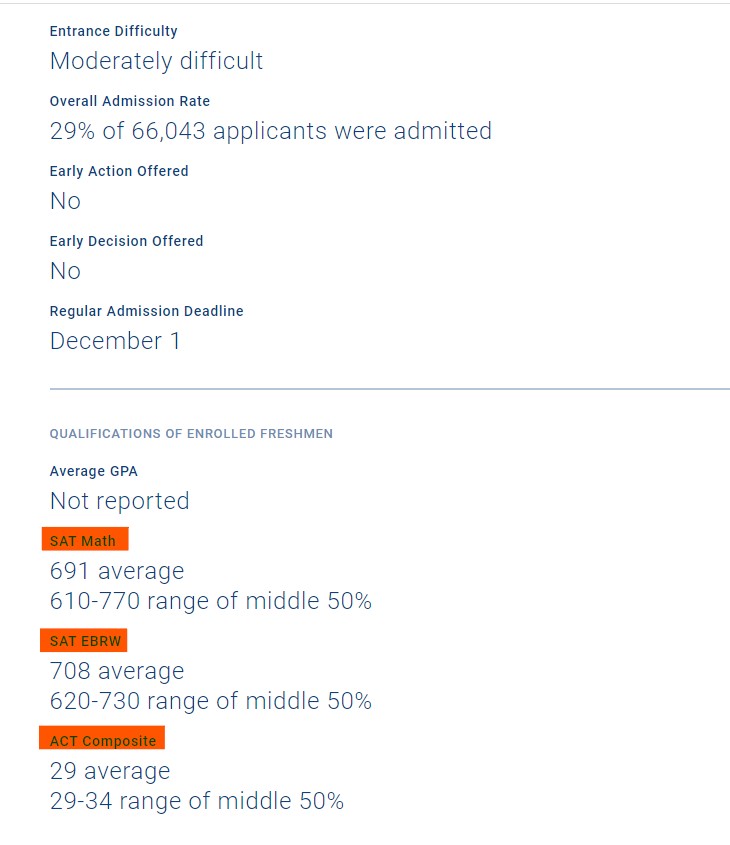
SAT and ACT test prep experts often say the first step in studying for the ACT or SAT is to find your “target” or “goal” score. To find your target score, look at the average test scores of recently enrolled freshmen at the colleges you plan to apply to. You can find these average scores in the College Profiles on CollegeData. The College Profile will report the “middle 50%” score range for the SAT’s English-Based Reading and Writing (EBRW) and Math tests, as well as the middle 50% composite ACT score, if the college reported it.

In the example below, University of Texas at Austin’s middle 50% ACT score range is between 26 and 33. This means 25% of enrolled freshmen at UT Austin scored below 26 on the ACT and 25% scored above 33. The remaining 50% of enrolled freshmen scored between 26 and 33. If you hope to be admitted to UT Austin, your target ACT score would fall at the higher end of this range and preferably above it.  

UT Austin's Average Test Scores

ut-austin-sat-act-avg-scores-2023

Source: UT Austin's College Profile, 2021-2022. CollegeData.com

You’ll want to look at the middle 50% score ranges for each college on your list, select the highest range among your colleges, and shoot for a score near the top or above this range. In other words, if the highest ACT score range for all colleges on your list is 26 – 33, your target ACT score might be 33 or 34.

How to find ACT and SAT Score Averages on CollegeData

To find the average SAT and ACT scores of enrolled freshmen at the colleges you are interested in, look up the college’s College Profile on CollegeData, using College Search. On the College Profile, the middle 50% SAT and ACT scores are displayed under “Qualifications of Enrolled Freshmen” on the Overview tab.

Your target score might also be influenced by scholarships from private organizations or colleges, which sometimes have a minimum SAT or ACT score to qualify.

If you’re studying for the PSAT, keep in mind the average scores for National Merit Scholarship consideration. The qualifying scores change each year and differ by state. Check with your guidance counselor to find out the qualifying scores for your state.

2. Take Practice Tests to See Where You Stand—and How You’re Improving

Taking practice SAT, ACT, or PSAT tests will help you determine your “baseline” score, and how far you need to go to reach your target score. Practice tests may also help you identify the areas of the test in which you are the strongest and weakest. It’s important to take an official practice test offered by the ACT or College Board (which administers the SAT and PSAT), because they are more likely to simulate questions you’ll see on the actual tests.

However, taking a practice test and noting your score isn’t enough. Kaplan test prep (the official ACT test prep organization) recommends that you go through every incorrect answer carefully to understand where you went wrong, familiarize yourself with the questions on the test, and analyze your results. You might find that you need to work on a certain type of question as opposed to an entire subject area.

3. Create a Test Prep Schedule

Test prep companies and private tutors have different advice and strategies for the number of study hours required to achieve different target scores. Regardless of your goals, a study schedule is critical. Your schedule might consist of a few hours of study a couple of days a week, or an hour every morning on weekdays with longer periods of study on the weekends. It depends on your goals, the number of areas you need to practice, and the time you have available to study.

It’s a good idea to set up a calendar mapping out your study plan up until your scheduled test day. It’s also important to take practice tests regularly to measure your progress and adjust your study time as needed.

Visit Kaplan’s website for a 3-month ACT test prep schedule or Khan Academy for a customized SAT practice plan.

4. Mix it Up

Use a variety of test prep resources. You might purchase a test prep book, subscribe to an SAT or ACT question of the day, watch YouTube videos, or download an SAT or ACT test prep app on your phone.

A virtual or in-person tutor, paid classes or an online study group are other ACT and SAT test prep options you might consider to add variety to your study routine. The ACT Academy and Khan Academy websites provide a variety of free SAT and ACT test prep options including videos, games and more.

Studying for the ACT or SAT can feel overwhelming. These tips should help set you off on the right study path and give you the best chance of achieving your test score goals. Good luck!


Become a BigFuture Ambassador

What Ambassadors Do?   Connect with Each Other Once a month, meet on Zoom for an hour in the evening. Betwee...