Showing posts with label student athletes. Show all posts

Friday, May 20, 2022

7 Tips To Prepare For The Athletic Recruitment Process

Competitive collegiate swimmer doing butterfly stroke in pool

Start making immediate progress with your athletic recruitment experience by following along with these seven tips.

Officially deciding to pursue your sport of choice in college is equal parts exciting and nerve-racking. Many of the nerves may stem from the athletic recruitment process itself, which contains a lot of gray areas and variables. As we continue navigating through a global pandemic, those uncertainties still hold true.  

The most important aspect of athletic recruiting -- and many things in life, really --  is finding a way to make incremental progress feel productive. The following seven tips will help accomplish that while allowing students participating in the athletic recruitment process to feel ready for the experience. 
 

7-tips-athletic-recruitment-1

1. Get Educated On the Process

Before jumping head-first into an endeavor, it’s a good idea to get educated on that particular topic as much as possible. For an experience with as many variables as athletic recruitment, taking time to read as much as you can on the topic could do a world of good — especially if this is the first time going through it. There are many websites and blog posts out there with accurate information and informed opinions. However, when I first start working with a prospective recruit, the first thing I recommend is that he or she read the NCAA’s Guide for the College-Bound Student Athlete.

This guide is helpful because it’s an all-encompassing resource on athletic recruitment. Some of the topics discussed include the varying academic standards for Divisions I, II, and III athletics, information on scholarships, national letters of intent, recruiting calendars, and much more. 

For those students who’d like to play varsity sports, but not at the NCAA level, there is also the National Association of Intercollegiate Athletics (NAIA). For information on how NAIA differs from NCAA, there is a college-bound student-athlete guide for that level, too.

2. Gather the Necessary Academic Information

For recruits who must market themselves to college coaches, it’s crucial to have all the necessary academic information on hand for whenever it’s needed. The goal is to make a coach’s job as easy as possible from a recruitment standpoint because it allows the coach to focus on what’s really important and shows that a potential recruit is serious about playing at the next level.

Academically speaking, there are a few things student-athletes should always have ready: an updated unofficial transcript, current year and/or next year’s course schedule, any available SAT/ACT scores (practice or official tests), and the dates of any planned future tests.

If a coach is interested in a recruit, he or she will want (among other information) the recruit’s relevant academic information to bring to the admissions office to see if that athlete would be a competitive applicant. Providing all this academic information to the coach makes his or her job much easier, and it provides clarity to a recruit much faster regarding whether or not he or she has a good shot at recruitment.

 

7-tips-athletic-recruitment-2

3. Gather the Necessary Athletic Information

In addition to giving coaches all the academic information necessary to do a pre-evaluation, student-athletes should be doing the same for their athletic information/background. The best way to present this is with an athletic resume. The formatting is completely up to the recruit — there is no right or wrong way to do it — but for those in need of guidance or creative inspiration, plenty of templates can be found from a simple Google search. 

While the formatting can vary, the information typically needs to be consistent. Some of the things that should be included are the following: 

  • The name and contact information for your high school/club coach
  • Any information regarding club/travel/AAU team(s)
  • Relevant personal details (date of birth, position, height, weight, and other similar information)
  • Relevant and/or most updated statistics
  • Any individual/team awards won during high school
  • Names of past camps/showcases/clinics that have been attended, and names/dates of any scheduled in the future

Again, this makes a coach’s job much easier, and he or she will be able to get a better read on a recruit who has all this information ready and organized to share.
 

7-tips-athletic-recruitment-3

4. Give Coaches Something to Look At

While creating a short highlight video has always been a good idea, it’s become crucial in a world where in-person recruiting has become extremely hard since the pandemic hit. All of the academic and athletic information is great to send, but for a coach to continue pursuing recruits from there, he or she typically likes to get a sense of a student’s athletic ability.

Brevity is important to strive for when creating and sending highlight videos. College coaches are typically expert multi-taskers, so time is always of the essence. They want to get all the pertinent details in a concise manner, which means about three to five minutes for highlight videos.

This gives a potential recruit plenty of opportunities to showcase his or her skills in both practice and game settings where he or she is easily identifiable. View this as one of the best marketing tools to display skills to as many people as possible, and don’t forget about using clips on social media periodically. Twitter, Instagram, and YouTube are common places students with whom I’ve worked have gotten noticed and contacted by coaches in recent years. 

5. Officially Get Into a Coach’s Recruitment Database

One of the best ways to begin a relationship with a college coaching staff is to send an introductory email. It allows the student to share all the information mentioned above, as well as controlling the narrative around this process a bit. However, there may be a whole host of reasons why a coach or the staff doesn’t respond right away (they’re in-season and busy, it’s a dead period, etc.). 

So, another way to officially get into a coach’s database is by filling out the prospective student-athlete questionnaire. This will typically live somewhere on a school’s official athletics homepage or on each of the team-specific pages. If you can’t find it, ask a college counselor. If that still doesn’t work, pick up the phone and call the admissions office.

While they vary by school and sport, here’s an example from Syracuse University to see the types of questions that are asked on a typical student-athlete questionnaire.
 

7-tips-athletic-recruitment-4

6. Create a System to Stay Organized

It’s very exciting to go through the process of reaching out to a coaching staff and have that action result in a genuine (and non-automated) response. It’s less exciting when that momentum is stifled because of a student’s lack of organization or not checking emails regularly.

I encourage my student-athletes to create some kind of tracking document or system to have everything in one place. As a starting point, general information to keep track of includes: name of college, coach's name and contract info, date of initial communication, date of coach's response, and date of highlight video/athletic resume sent. 

Simply staying organized may help students to take advantage of any progress or opportunity that comes their way.
 

7-tips-athletic-recruitment-5

7. Register With the NCAA Eligibility Center

Students are technically allowed to register with the NCAA Eligibility Center at any point in their high school career. With regard to the overall recruiting timeline, though, it’s best to have this registration completed by the start of junior year. The Eligibility Center certifies whether a recruit is qualified to play Division I or II sports based on the student’s academic record, standardized test scores, and amateur status. Registering with the NCAA Eligibility Center by the start of junior year is another one of those small details of this experience that can show coaches a prospective recruit is serious about playing sports at the college level. 

We all feel good when we make progress on dreams and goals. Hopefully, these seven tips will act as a beginning checklist to help student-athletes and their families pick up some immediate momentum in the early stages of this experience.

Matt Musico, a current college counselor at Collegewise is a freelance writer for CollegeData. He has worked in higher education for the better part of a decade. Half of that time was spent working in an undergraduate admissions office, while the other half has involved working with high school families as a private college counselor.

Friday, May 13, 2022

7 Questions Parents of High School Athletes Should Ask

Lexi Langendorf/Collegiate Parent Blog

The NCAA states that it represents almost half a million student athletes, meaning there is a large audience of parents who expect to help their child through the college athletics experience. However, many parents are unfamiliar with the process of transitioning from high school to college-level athletics and may not know what to pay attention to and be critical of.

When an athlete commits to a college or university, they're committing to more than just the school’s sports program. There are other important variables to consider, such as mental health and academics. Drawing from my own personal experience as well as expert suggestion, here are seven important questions every parent of a high school athlete should ask and have answered before making a college decision.

1. How well does your student know the coach?

Coaches want to recruit talented athletes to play for them. So be aware that some of them will tell your high school student whatever they want to hear in order to keep their interest.

Amanda Charpentier, former Judson University women’s volleyball player, said she wished she had known her coach better before committing to play on her team.

“A coach can help encourage and develop players,” Charpentier said. “Or they can have the opposite effect. Knowing your coach can help you learn which type of coach they will be.”

After meeting a college coach, make sure you have a good grasp on whether or not the coach cares about your student’s well-being beyond just athletics, including their academics, social life, mental health and physical safety.

Compare the coach's characteristics to those of coaches your student has had in the past and see how they measure up to your personal expectations of a good coach.

2. Can your student envision spending extensive time with the team?

Team members generally view new players as either a positive or negative thing. As a result, it can be easy to read whether or not the team is going to be a good fit for your student.

When meeting with the team, observe whether they appear genuinely interested in your student and ask them lots of questions. If the team seems excited about the possibility of your student joining their program, this is a great sign. However, if the team is quieter and looks like they’re “sizing up” your student as competition, this may be a red flag.

Your student will be around these people more than anyone else throughout their college experience, so it’s important to get to know them before signing day.

3. Are they prepared to compete with their teammates for play time?

Even if your student was recognized as one of the best players on their high school team, they aren’t guaranteed playing time in college.

Dr. Ramel “Kweku” Smith, PhD, LP,  University of Wisconsin Madison’s senior psychologist in clinical and sport psychology services, said that many student athletes deal with pressure to be the best on their teams.

“For most collegiate athletes, they’re leaving circumstances where they were ‘the person,’” Smith said. “And then to come into an environment where you’re one of many people, and maybe sometimes nowhere even near the best, then that can obviously create situations. But it’s a good pressure in some ways to always be the best.”

Ask your student if they love the sport enough to value winning and team success over playing time and enjoyment, especially if they're considering playing in a higher division.

“I wish I'd asked myself if I valued competition way over fun,” Charpentier said. “Because more often than not, it was not fun.”

4. How do you rate the athlete support resources and athletic facilities, such as the field/fieldhouse and weight room?

Your student athlete will spend a lot of time at the fieldhouse or field and the weight room. Therefore, it’s important that they can see themselves being happy in those places.

Consider the size of the field or fieldhouse, the floors or turf, the equipment, the bleachers and the scoreboards.

Check out the weight room and determine whether it’ll be big enough for team workouts or if it will be crowded. Ensure there is sufficient equipment that is safe and high-quality.

Is there a trainer who treats injuries? Is there a strength and conditioning coach who programs workouts for athletes? Dr. Smith said that also having a sports psychologist on campus is important in achieving mind and body parity.

5. Will your student be happy with the campus beyond the athletic facilities?

From small liberal arts colleges to big state research universities, campuses vary widely. Before you visit an individual school, research its layout and surroundings. Consider the school’s location in relation to your home town if your student has family, friends or community ties that they want to stay close to.

If the college or university is located in a rural area, make sure your student is okay with not having many restaurants or stores nearby. You may also want to research the safety of the surrounding area.

As you walk from place to place during a college tour, try to see it through your student's eyes and evaluate whether the campus would work for them long term. Be critical of things that could possibly cause issues and ask your student how they feel about the size and environment of the school.

More about why location matters when choosing a college >

6. Will your student struggle with their mental health?

The mental health of college athletes is often overlooked. In some cases, it becomes difficult for student athletes to adjust to the college lifestyle and manage their time effectively. In other cases, pre-existing conditions begin to affect a student athlete’s performance.

Dr. Smith said that the most common issue student athletes come to him about is anxiety.

“Anxiety is a fear of the future,” Smith said. “So specifically for athletes, ‘how am I going to perform for this conference coming up, for this practice coming up?’ Those types of fears.”

According to the American College of Sports Medicine (ACSM), approximately 30% of women and 25% of men who are student athletes report having anxiety. However, there are resources available to athletes to help them through their college experience, such as tutors and sports psychologists.

Additional resources for supporting your student's mental health >

7. Will the academic program provide everything your student needs to be successful after graduation?

According to the NCAA, fewer than two percent of NCAA student athletes go on to be professional athletes. This means that the vast majority of student athletes depend on their education to prepare them for life after college.

Don’t overlook the academic profile of the college or university your student is considering. Does the school offer a program of study your student wants to pursue? If so, make sure that the major they select will be beneficial to them when it comes time to look for a job after graduation.

Look at the course catalog with your student to see what classes are offered in their major of choice. Sit in on a class or two and if possible meet with professors.

Also inquire about extracurricular, job and internship opportunities wherever possible. Think about the things beyond the sports program that will make your student successful after graduation.

It's easy to make the mistake of prioritizing a school's sports program over the university's other features. However, asking the seven questions above will help your student athlete make the right college decision and prevent them from experiencing regret later on.


Friday, September 24, 2021

Are Your Student-Athletes Ready to Play?


NCAA High School Newsletter
September 2021

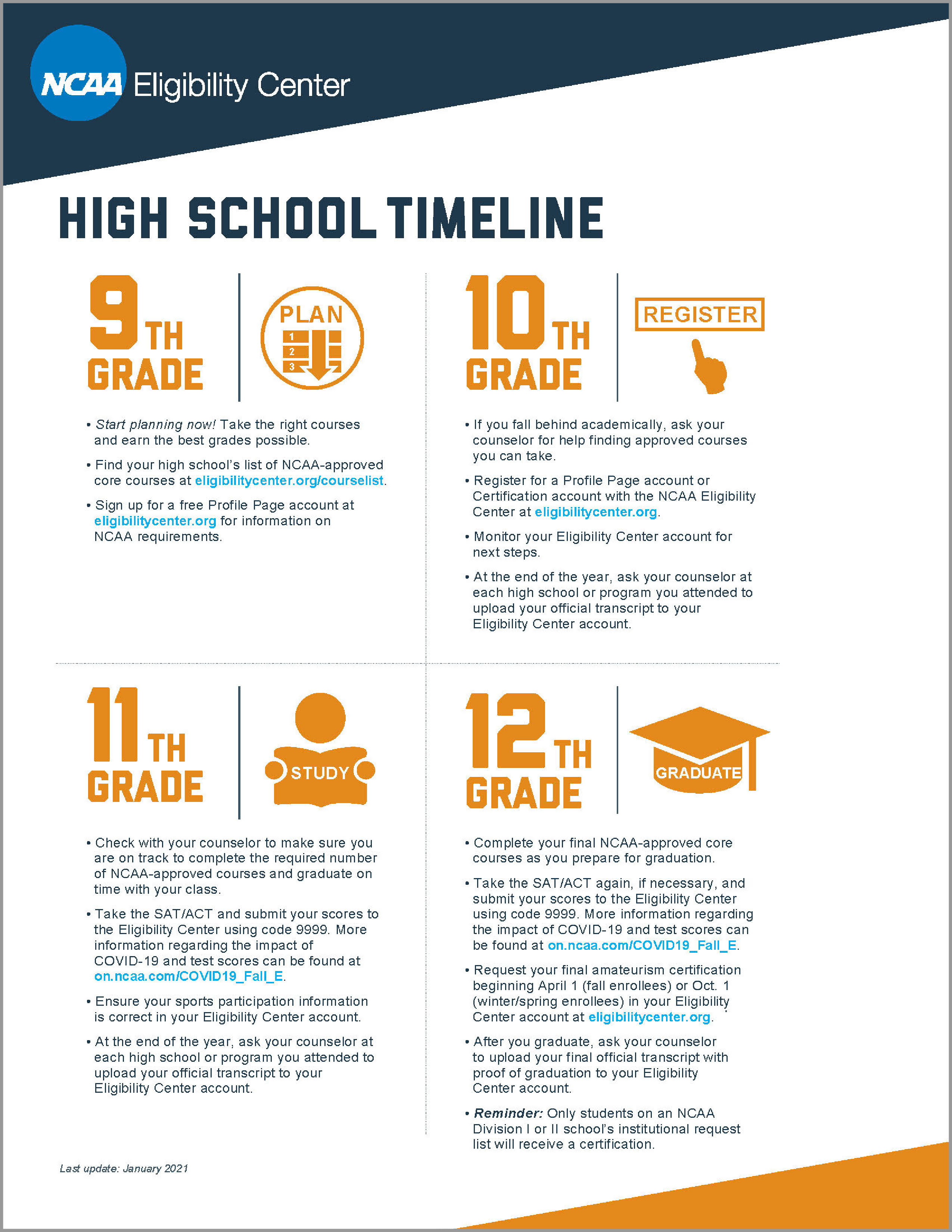
High School Timeline


Check our High School Timeline

As your student-athletes move semester by semester toward their dreams of collegiate play, initial-eligibility standards help ensure they are prepared to succeed in college. It's vital your student-athletes plan ahead and take their high school classes seriously. Encourage your student-athletes to use our high school timeline as a way to stay on track for meeting NCAA initial-eligibility requirements.
  • Click here for resources to share this timeline on your social media and newsletters.
Remember, NCAA core-course GPA starts in ninth grade!
Encourage your incoming ninth graders to register during eighth grade with a free Profile Page account so that they have time to plan for their ninth-grade classes. Click here for a checklist students can use during the registration process.

Become a BigFuture Ambassador

What Ambassadors Do?   Connect with Each Other Once a month, meet on Zoom for an hour in the evening. Betwee...