
Showing posts with label SAT Prep. Show all posts

Friday, May 5, 2023

Tips and Resources for SAT Prep, ACT Prep and PSAT Prep

By CollegeData

female student studying by a lake

Whether you plan to enroll in a test prep course or study by yourself, you’ll want to make the most of your SAT, ACT and PSAT study time. These 4 tips can help keep you motivated and on track to do your best on test day.

1. Determine Your Target Score

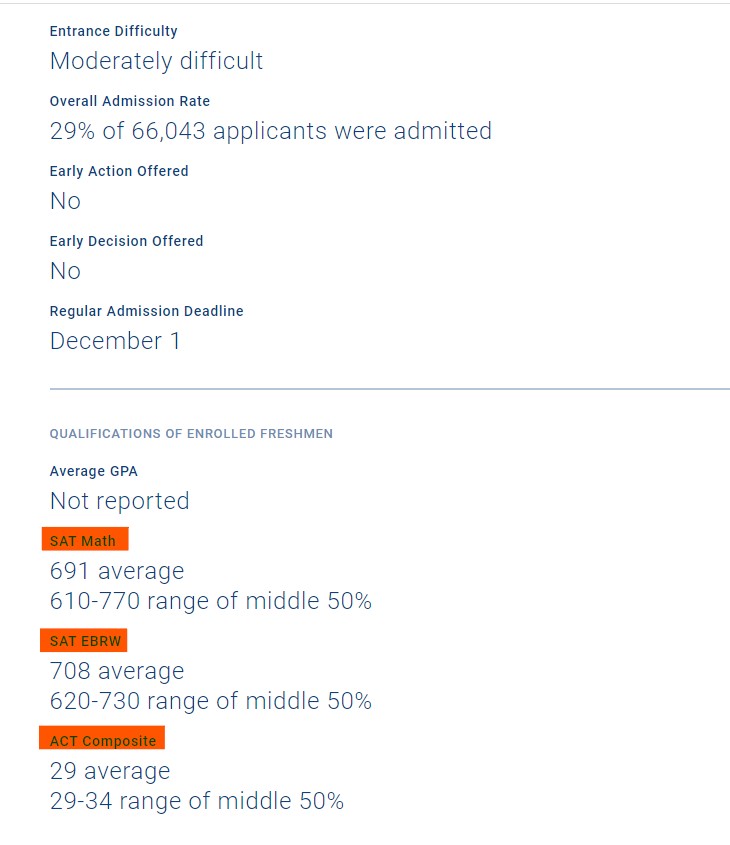
SAT and ACT test prep experts often say the first step in studying for the ACT or SAT is to find your “target” or “goal” score. To find your target score, look at the average test scores of recently enrolled freshmen at the colleges you plan to apply to. You can find these average scores in the College Profiles on CollegeData. The College Profile will report the “middle 50%” score range for the SAT’s English-Based Reading and Writing (EBRW) and Math tests, as well as the middle 50% composite ACT score, if the college reported it.

In the example below, University of Texas at Austin’s middle 50% ACT score range is between 26 and 33. This means 25% of enrolled freshmen at UT Austin scored below 26 on the ACT and 25% scored above 33. The remaining 50% of enrolled freshmen scored between 26 and 33. If you hope to be admitted to UT Austin, your target ACT score would fall at the higher end of this range and preferably above it.  

UT Austin's Average Test Scores
ut-austin-sat-act-avg-scores-2023

Source: UT Austin's College Profile, 2021-2022. CollegeData.com

You’ll want to look at the middle 50% score ranges for each college on your list, select the highest range among your colleges, and shoot for a score near the top or above this range. In other words, if the highest ACT score range for all colleges on your list is 26 – 33, your target ACT score might be 33 or 34.

How to find ACT and SAT Score Averages on CollegeData

To find the average SAT and ACT scores of enrolled freshmen at the colleges you are interested in, look up the college’s College Profile on CollegeData, using College Search. On the College Profile, the middle 50% SAT and ACT scores are displayed under “Qualifications of Enrolled Freshmen” on the Overview tab.

Your target score might also be influenced by scholarships from private organizations or colleges, which sometimes have a minimum SAT or ACT score to qualify.

If you’re studying for the PSAT, keep in mind the average scores for National Merit Scholarship consideration. The qualifying scores change each year and differ by state. Check with your guidance counselor to find out the qualifying scores for your state.

2. Take Practice Tests to See Where You Stand—and How You’re Improving

Taking practice SAT, ACT, or PSAT tests will help you determine your “baseline” score, and how far you need to go to reach your target score. Practice tests may also help you identify the areas of the test in which you are the strongest and weakest. It’s important to take an official practice test offered by the ACT or College Board (which administers the SAT and PSAT), because they are more likely to simulate questions you’ll see on the actual tests.

However, taking a practice test and noting your score isn’t enough. Kaplan test prep (the official ACT test prep organization) recommends that you go through every incorrect answer carefully to understand where you went wrong, familiarize yourself with the questions on the test, and analyze your results. You might find that you need to work on a certain type of question as opposed to an entire subject area.

3. Create a Test Prep Schedule

Test prep companies and private tutors have different advice and strategies for the number of study hours required to achieve different target scores. Regardless of your goals, a study schedule is critical. Your schedule might consist of a few hours of study a couple of days a week, or an hour every morning on weekdays with longer periods of study on the weekends. It depends on your goals, the number of areas you need to practice, and the time you have available to study.

It’s a good idea to set up a calendar mapping out your study plan up until your scheduled test day. It’s also important to take practice tests regularly to measure your progress and adjust your study time as needed.

Visit Kaplan’s website for a 3-month ACT test prep schedule or Khan Academy for a customized SAT practice plan.

4. Mix it Up

Use a variety of test prep resources. You might purchase a test prep book, subscribe to an SAT or ACT question of the day, watch YouTube videos, or download an SAT or ACT test prep app on your phone.

A virtual or in-person tutor, paid classes or an online study group are other ACT and SAT test prep options you might consider to add variety to your study routine. The ACT Academy and Khan Academy websites provide a variety of free SAT and ACT test prep options including videos, games and more.

Studying for the ACT or SAT can feel overwhelming. These tips should help set you off on the right study path and give you the best chance of achieving your test score goals. Good luck!


Friday, February 11, 2022

SAT Test Prep and Dates

Does the thought of college planning feel a bit daunting? We have a fix for that. The SAT offers custom test prepfree practice tests, and resources you can use at your own pace . As a result, you can focus on one section at a time and improve your skills where you need them most.

Many students in the class of 2023 will take the SAT once this spring and then again this coming summer or fall. While the SAT is optional for many colleges, it still helps you stand out on those college applications. Go at your own pace, and test when you’re ready. Once you do, the SAT can show how you’re focused, ready to work, and invested in your education.

Here are the upcoming spring 2022 registration dates:

Regular DeadlineLate DeadlineSAT Test Date

February 11

March 1

March 12

April 8

April 26

May 7

May 5

May 25

June 4

Register Now

Sincerely,

College Board

Tuesday, November 2, 2021

Online Tools That Can Support ACT, SAT Prep

Various virtual test prep resources can help you focus, maximize study time, retain information and perform better.

When we envision digital tools geared for SAT and ACT prep, certain resources immediately come to mind: online practice tests, flash cards and the like. But a wealth of other tech tools are also available to SAT and ACT test-takers, and you could deeply benefit by using some of them as you study.

Diversify your SAT and ACT test prep and maximize your study efficiency by adding these online resources to your routine:

Focal aids that enable distraction-free studying
Tools that encourage efficient time management
Electronic flashcards that use spaced repetition
Video tutorials with explanations and examples

Focal Aids That Enable Distraction-Free Studying

Most study sessions start with good intentions of productivity. Unfortunately, students are surrounded by seemingly endless stimuli that can distract from that goal. Whether you're distracted by noises from outside or your family pet, or just too tempted to refresh a social media app, you may find yourself struggling to stay focused on the task at hand.

One of the easiest ways to reduce distractions is to activate your phone's "do not disturb" mode. This function silences all app notifications, calls and texts as long as your phone stays locked. Once you unlock it, you will see – and possibly hear – all notifications as you normally do. With most cellphone models, you can turn on the no-disturb option quickly from the main drop-down menu.

If your cellphone is an especially large distraction to you, consider using an app like OFFTIME that allows you to mute notifications, restrict or limit access to certain apps, track your phone activity and more. A full version of the app for Androids is free on Google Play with in-app purchases, and a version for Apple iOS devices costs 99 cents.

Another option is to purchase a mobile phone "jail" available on Amazon and elsewhere. Once your phone is locked inside, ask someone to hold the key for you until your study session is over.

Tools That Encourage Efficient Time Management

The Pomodoro Technique is a proven and simple strategy that can help you make the most of your time. It consists of setting a timer for 25 minutes, working efficiently during that period and then taking a break of typically about five minutes. Note that taking a break is not a suggestion but a required step of the process.

The Pomodoro Technique can be repeated as many times as is necessary, though students should be aware of how long they can realistically work before fatigue sets in. To get started, use a traditional timer, the one on your oven or cellphone, or the free virtual one at TomatoTimer.

Time management is closely linked with task management, another skill that students should hone during test prep. Consider downloading Remember the Milk, a free app that lets you set and categorize reminders in several ways, including by due date, priority and subject. With such apps, you do not have to worry about handwritten reminders that could get lost or overlooked.

Electronic Flashcards That Use Spaced Repetition

Spaced repetition is a learning technique that involves electronic flashcards shown according to several algorithms. Flashcards that contain new and difficult content are shown more often than those with familiar and easy material. When an incorrect answer is given, the flashcard is flagged for more frequent review.

Spaced repetition is especially helpful for learning vocabulary and formulas, which are essential to success on both the ACT and the SAT. Explore Anki and Brainscape, two websites that allow you to make your own flashcards, access others' flashcards and study via spaced repetition.

Video Tutorials With Explanations and Examples

For explanations of specific concepts, question types and test-taking techniques, YouTube is a powerful resource. For concise math lessons, you might benefit from following the Mathademics channel, while Grammar Girl offers quirky overviews of writing and grammar topics such as punctuation marks, commonly confused words and misplaced modifiers.

And, of course, a great many videos are specifically geared toward ACT and SAT prep strategies. One important thing to note is that the ACT and SAT overlap quite a bit, so if you find videos helpful as you study for one test, the lessons will generally carry over to the other, as well.

Other Online Resources and Apps

Remember to take advantage of the resources noted above, as well as the more familiar options such as online practice tests.

The official creators of the ACT and SAT offer free sample exams, an excellent place to begin. You can locate additional practice problems by searching "ACT" or "SAT" in your cellphone's app store. Many apps, such as ACT Online Prep for Android and Apple devices, exist in this space. Some even target specific sections of each test.

Varsity Tutors, the company that writes the College Admissions Playbook blog, also has free ACT and SAT classes that you can attend online.

As you prepare for the ACT or SAT, remember that these virtual tools can help you maximize test-day performance.

Become a BigFuture Ambassador

What Ambassadors Do?   Connect with Each Other Once a month, meet on Zoom for an hour in the evening. Betwee...