|

|
The School of Business at Stevens Institute of Technology is offering a paid virtual summer research program for high school students. The Stevens Select Summer Scholars Program is a six-week program where students will have the opportunity to participate in an online research course taught by School of Business professor Dr. Donald Lombardi that covers topics such as: organizational leadership, entrepreneurship, finance, and marketing. The final assignment will include a PowerPoint presentation detailing the participants’ research findings profiling a Fortune 500 company.
The program will run from July 8, 2024, through August 12, 2024, and students will receive a $500 stipend after completing the program.
Eligibility: Applicants must currently be in their junior year of high school (no exceptions).
Deadline: Applications are due by March 1, 2024.
Notification: Applicants will be notified by April 1, 2024.
The application packet must include all the following:
Feel free to share this application link with your students who are in their junior year.
If you have any questions about this program, please reach out to Lindsay Hartelius at businessresearch@stevens.edu
From the College Essay Guy
This college admissions timeline tells you what tasks to prioritize each year of high school in order to prepare for college.
Inside, you’ll find tons of resources for finding out how long the admissions process takes, when you should begin preparing (hint hint, now), and even when to take those pesky standardized tests.
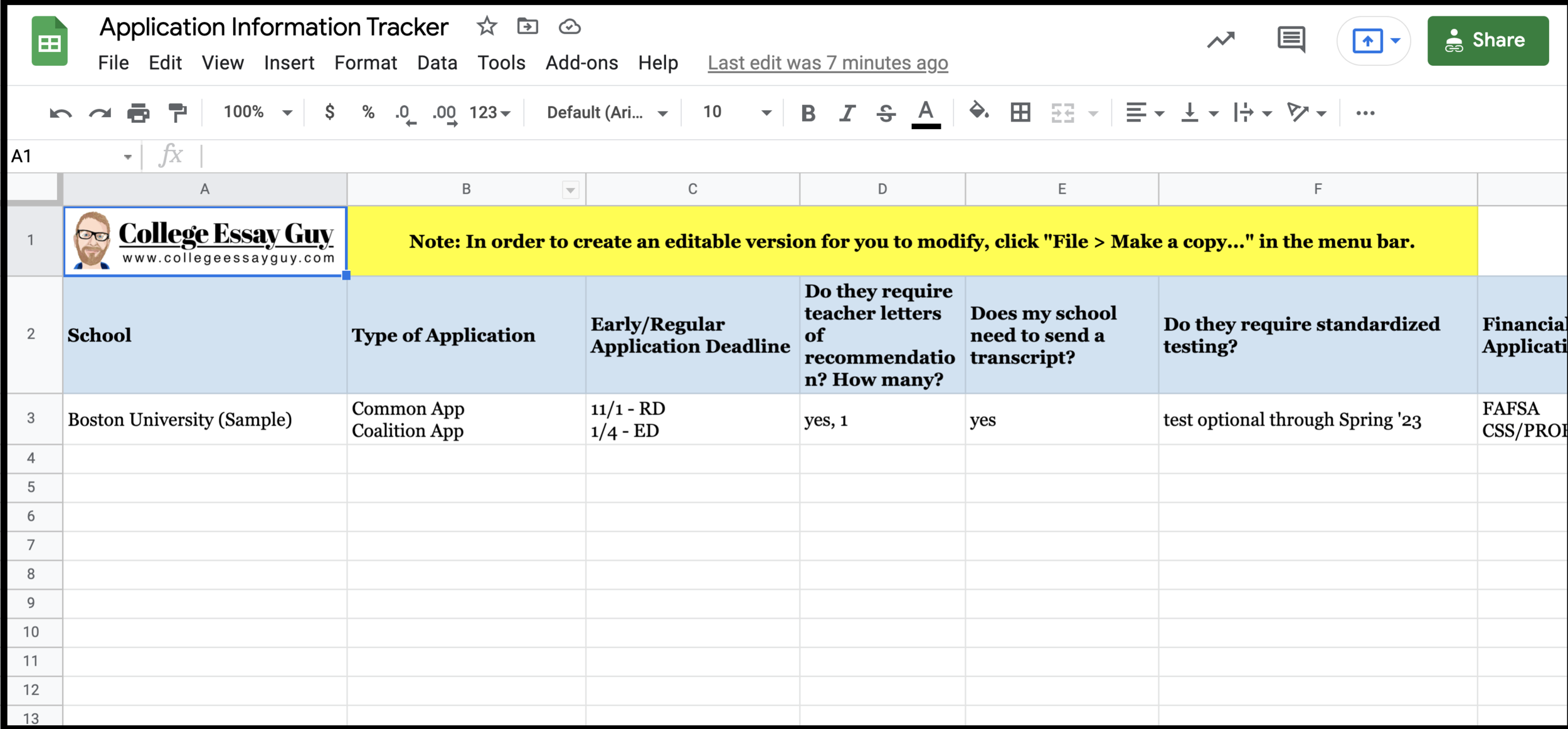
Click here to download our simple college application information tracker
Do the Values Exercise to determine what’s important to you.
Take a personality assessment to learn more about your strengths, challenges, and communication and learning style.
Explore and engage with extracurricular activities (e.g., clubs, sports, community service, fine and performing arts, work, and other in-or out-of-school activities) that align with your values and strengths
Create an activity log to track all your extracurricular activities, summer experiences, academic honors, and other achievements.
Develop your time management and study skills.
PSAT: Some high schools allow you to take the October PSAT as a freshman.
Take an interest assessment to explore possible college majors and careers.
Plan your high school classes using insight from the bullet above.
Meet with your school counselor to explore clubs, classes, and discuss course selection. Start building a relationship with them by doing this regularly.
Parents: Start exploring how to pay for college.
Athletes: Familiarize yourself with the NCAA and NAIA athletic recruiting requirements.
Plan a summer experience that helps you explore a passion or interest.
Summer reading: Expand your vocabulary and your world.
Do the Values Exercise to see if your ever-evolving self has new priorities. If they’ve changed, assess whether you want to change your current activities so they align with your values.
Continue participating in non-academic extracurricular activities. See if you can deepen your involvement or take on a leadership role in the activities you’ve already been doing. Or step outside your comfort zone and try something new.
Update your activity log.
Stay focused on keeping your grades up--this year’s grades are important to college admissions officers.
If your school offers higher-level (honors or AP) classes, challenge yourself academically by taking one a higher-level (honors or AP) class or two (honors or AP classes), in areas that you’re interested in.
PSAT: Some high schools allow you to take the October PSAT as a sophomore.
Attend a local college fair.
Meet with your school counselor at least once a year to discuss course selection. Continue building this relationship by asking lots of questions about new courses and suggestions for ways to develop your interests..
Parents: Continue researching how to pay for college and set up a college budget.
Visit a college or two locally or while you're on vacation.
Read more about possible college majors and careers to better plan out your high school classes.
If you think you may play Division I or II sports in college:
Register for the National Collegiate Athletic Association (NCAA) Clearinghouse.
Register for the National Association of Intercollegiate Athletes (NAIA) Eligibility Center.
Familiarize yourself with National Collegiate Athletic Association (NCAA) requirements. Then double-check that all of your courses are NCAA-approved. Not all high school classes count towards their requirements.
Let your high school counselor know you’re considering college athletics.
Testing
If you're taking an AP class this year, consider sitting for the AP exam (May). If you're concerned about your readiness, check in with your teacher for advice.
At the end of the school year, take a practice ACT and SAT to determine which test may be better for you, then set up a testing timeline.
Summer reading: Continue expanding your vocabulary and your world.
Continue exploring your interests during the summer. This could be through a job, internship, volunteer experience, or self-designed project.
FALL
Check in with the Values Exercise. Has anything changed?
Stay consistent with your non-academic extracurricular activities if your values and priorities haven’t changed. If they have, try something new. Continue to look for ways to explore and deepen your interests in these activities. Try a leadership role if you haven’t already.
Continue to update your activity log.
Start your college search by attending a local college fair and a few college admission rep presentations at your high school (if they are offered).
Explore your college interests by sorting the college criteria on www.Corsava.com. Then use those preferences to searches for a few college matches.
Start a preliminary list of colleges to visit using the results of your college match searches. Have a family meeting to block out dates for college visits throughout junior year.
Keep your grades up. Junior year grades are the last ones some schools will see before making an admissions decision.
Take an aptitude or career assessment such as YouScience to learn more about your interests and strengths, which will change as you grow and learn.
Continue challenging yourself academically with higher level AP or honors classes.
Schedule a meeting with your school counselor to discuss the colleges you are interested in. Tell them about your college preferences and ask for their suggestions of colleges that might be a good fit for you. Continue to develop your relationship with your counselor.
Testing
Take the PSAT/NSMQT in October. This test qualifies students for the National Merit Scholarship.
Stay on track with your ACT/SAT testing timeline and study schedule.
Athletic Recruitment
Double-check that your classes meet the NCAA Clearinghouse requirements
Complete online athletic recruitment forms for each college you're considering. You'll find these on the college's website under "athletics."
Once you’ve completed the online recruitment forms, make your sports resume and recruitment videos.
Spread out your correspondence with coaches by sending the resumes and video a few weeks after you complete the online forms.
Fine & Performing Arts Students
Sign up for Performing & Visual Arts College Fairs.
Create an admissions requirements spreadsheet for fine and performing arts programs.
You most likely need to create a portfolio and audition materials, so spend junior year working on pieces.
WINTER & SPRING
Investigate summer experiences.
Register for senior year classes. Remember colleges will want to see a strong senior year course load including five academic core classes.
Continue visiting colleges. Use local colleges to sample certain types of schools (single-sex, small liberal arts, larger university, etc.)
Start building your college list based on your values and your research.
Start researching scholarship opportunities.
Complete the Letter of Rec questionnaire and request letters of recommendation from two academic teachers from junior year.
Testing
Select testing dates. Most likely your first ACT or SAT will take place between December and May.
Take the AP/IB exams in May.
Athletes
Send your sports resume and video to college coaches and fill out the athletic recruitment surveys on the college websites.
Fine & Performing Arts Students
Explore how the audition and portfolio process works for college admission.
Build your portfolios and audition videos.
Set up a meeting with your school counselor to ask questions about college choices, your senior year schedule, testing, and anything else you're curious about.
SUMMER
Participate in summer experiences (research, reading, internships, fun stuff).
Refine and finalize your college list. Be sure it reflects a balance of admission probabilities (likely, possible, and reach schools).
Research the type of applications required for each school on your list, as these vary.
Complete the Common Application.
Visit more colleges.
Research the admission requirements and deadlines for schools on your list and create a spreadsheet to organize information. Research to see if an interview is offered or required at each school.
Create a scholarship spreadsheet to list deadlines and requirements.
AUGUST & SEPTEMBER
Confirm your final college list, application deadlines, and requirements.
Write your college-specific supplemental essays.
Ask an expert outside reader to review your Common Application and personal statement.
Continue to research scholarships, adding requirements and deadlines to your list.
Set up on-campus or local rep interviews with colleges.
Check in with your recommendation writers. Update your Letter of Rec Questionnaire and ask for a letter of recommendation from your school counselor.
Apply to scholarships throughout the school year.
Parents: Start preparing financial aid paperwork and develop a deadlines list.
SEPTEMBER - NOVEMBER
Complete and send out all EA and ED applications no later than late October. (These deadlines are typically around November 1. )
Many portfolio-based arts programs have December 1st deadlines. And some universities require submission by December 1st to be considered for scholarship opportunities. Schedule a meeting with your school counselor to review your college list to get his or her feedback and review your application deadlines, and ask any questions you may have.
Attend high school presentations and programs.
Apply for financial aid using the FAFSA and CSS/PROFILE (if required).
Completed final college visits.
Send test scores to your colleges after checking whether they allow self-reported scores.
Ask your school counseling office to deliver letters and transcripts to colleges.
DECEMBER
Regular Decision (RD) deadlines are typically around January 1. Complete and send out all RD applications no later than mid-December. Give yourself a relaxing holiday break by completing your applications before November 15.
JANUARY - MARCH
January: If deferred, send an email to your region/state/country admissions representative. Reaffirm your interest in the school and offer any updates (activities, achievements, awards, etc).
Wait for application decisions.
MARCH - APRIL
Colleges have until April 1 to release decisions.
Plan visits to accepted colleges, if needed, in order to make your final college choice.
Attend local admitted student events when possible.
Evaluate financial aid packages and scholarship offerings to figure out how to pay for college.
Students need to enroll and submit a deposit by May 1.
MAY
Take AP/IB exams.
Notify your school counselor of your college decisions and scholarship opportunities.
If you've been waitlisted, this is a good time to send a)your “I'd like to stay on the wait list" form and b) the email to your designated admissions rep which states your interest in the school and offers updates (activities, achievements, awards, etc).
Sign-up for campus housing if you plan to live on campus.
JUNE - AUGUST
Continue saving for college.
Check your email for waitlist notifications.
Attend orientation sessions.
Sign up for meal plans and register for classes.
Find out what you need for your dorm and classes, and go shopping.
Contact your future roommate(s).
Make travel and move-in arrangements.
Set up a bank account on or near campus.
Continue applying for scholarships.
Set up a meeting with an academic advisor at your college to plan your classes.
To learn more about how to have an amazing pre-college summer, click here!
By Suzanne Shaffer from Collegiate Parent
Inside Higher Ed reports that the Common Application, which is widely used by over 900 colleges, saw an increase in applications this past year. As of February 15, over 1 million distinct first-year applicants applied to college, an increase of 13.9 percent over 2019–20 numbers.
The Common App Reports and Insights shows there were substantial increases in underrepresented minorities and first-generation applicants. Minority applications increased 21 percent; first-generation applications increase at nearly twice the rate of other applicants over the same period. International applicants nearly tripled the rate of domestic applicants.
What does this mean for your student? Increased applications means increased competition. Your student should position themselves to stand out in the applicant pool and be strategic in which colleges receive their application in the fall.
Test-optional policies generally provide students with more flexibility in how they position themselves in the college admissions process. Test-optional doesn’t necessarily mean "test-blind," however. Just because a school doesn’t require students to submit SAT or ACT scores doesn’t mean that a strong testing performance won’t work in a student's favor. If a college is “test-blind” it will not accept test scores and will not use them to influence an admission decision. Some colleges are “test-flexible,” meaning students can provide AP and IB test scores in lieu of their SAT or ACT.
According to a recent study, “the number of students admitted from the waitlist rose 97% from 22,223 in 2019 to 43,867 in 2020.” This past year, the trend continued.
Wait lists can be perceived as good news or bad news. On the one hand, if your student is waitlisted, there is a possibility they will be offered admission. It’s an opportunity for students to assess their options. If the school is your student’s top choice, they should be proactive and communicate that with the college. On the other hand, waitlists are a gamble. Your student should always carefully consider the other colleges who offered them admission.
Colleges across the country took huge hits in international student enrollment during the 2020–21 school year due to travel restrictions imposed by the pandemic. During the 2020–2021 admissions cycle, international enrollment fell by as much as 43%.
After this dramatic downfall, international enrollment has more than rebounded during the 2021–2022 admissions cycle, with a reported 63% increase from the prior year.
Given the importance of students with varying perspectives and backgrounds, this influx of diversity could add tremendous value to college campuses across the U.S. and it’s expected colleges will pursue this diverse group in the upcoming admission season.
Even though COVID-19 numbers continue to decrease, parents and students might be hesitant to believe college campuses will return to normal. All the flip-flopping over the last two years has certainly made them reluctant to commit to paying for an expensive college education if that education changes again. Gap years could still be a viable option for many students.
In addition, there will continue to be high numbers of transfers. Many students who didn’t have a chance to tour a college before enrolling, or opted to attend a local community college, will be interested in transferring to schools that better meet their needs and goals.
As a result of this increased emphasis on value, increasing numbers of applicants will be drawn to colleges with sizable financial aid, work-study programs, opportunities to graduate in three years as opposed to four, and colleges with lower net prices. Families may also focus on state schools, which are generally the more affordable option for students who live in the state.
SAT Subject II tests have been eliminated permanently. In the past, they were used to prop up course rigor and gaps in grades. They were used to show evidence of course mastery and college readiness. With their elimination, more emphasis will be placed on AP classes and AP test scores. Some colleges will look at AP scores to assess college readiness.
Colleges are looking to improve their optics with regards to diversity, equity, and inclusion. This will certainly affect their admissions policies. Therefore, record numbers of students who represent diversity in terms of race, income, disability, gender and other groups will be offered admission. This also includes first-generation students.
Hand in hand with the priority to cast the net for talent as wide as possible is the trend at many schools, including Amherst College in Massachusetts, to abolish legacy preferences in admissions. This doesn't mean the children of alumni won't be accepted at elite institutions but they'll need to qualify for admission completely on their own merits.
With more and more colleges making standardized test scores optional, the essay and supplemental essays in the college application will play a more significant role in the admissions decision.
In addition, the SAT essay has been discontinued and unless your student takes advantage of the ACT essay, admissions officers will only have their application essay when making an admissions decision.
Not only does this essay provide the college with unique information into the student’s background and abilities, it gives them the opportunity to gauge the student’s writing ability. The application essay can be a deciding factor in an admission officer’s decision to accept or deny admission.
What Ambassadors Do? Connect with Each Other Once a month, meet on Zoom for an hour in the evening. Betwee...


