Showing posts with label ACT. Show all posts

Monday, September 18, 2023

Should You Guess on the SAT or ACT?

From: Princeton Review

Have you ever heard of the infinite monkey theorem? It says that a monkey, given an infinite amount of time to type randomly on a typewriter, will eventually type out the complete works of Shakespeare. Given an infinite amount of time to fill in answers on a standardized test, a high school student could also randomly bubble in all the correct answers—eventually. Unfortunately, you will not have an infinite amount of time to guess all the answers on the SAT or the ACT. You will probably end up guessing on some of the questions. And that’s OK! You should guess when you don’t know the answer, when you’re running out of time, or when the question is going to take way more time than it’s worth. We’re going to help you guess strategically so that you can maximize your points—even when you don’t have all the answers.

The Guessing Penalty

First things first: There is no guessing penalty, so you’ve got nothing to lose by guessing. That wasn’t always the case. Prior to March 2016, the SAT did have a guessing penalty; a quarter of a point was subtracted from your raw score for every wrong answer. Since right answers were worth one point each, random guessing was likeliest to result in a score of zero. (With five answer choices, you’d pick the right answer about 20 percent of the time. You’d get 1 full point for the correct answer and lose 0.25 points for each of the 4 wrong answers—all of which would sum to zero.)

When the College Board revised the SAT in 2016, they made it more like the ACT, which has never had a guessing penalty. At present, a wrong answer on either test does nothing to your score—it won’t hurt it, but it can’t help it either. Many students (and their parents) remember the old guessing penalty, and they are afraid to take a chance on a question. That fear of guessing incorrectly can prevent students from picking up a few extra points. Don’t be held back! All you need is a solid guessing strategy.

When to Guess on the SAT and ACT

As you work through each question of an SAT or ACT test, ask yourself, “Can I answer this quickly and accurately?” If the answer is “Yes,” then do the work carefully and answer that question. If the answer is “Maybe,” then save that question until you’ve answered all the others that are better matched with your skill set. If the answer is, “Heck, no!” fill in an answer right then and there. You may think you’ll have time to come back to it, but if you don’t, and time runs out before you fill in that bubble, you will have no chance of picking up that point.

What to Guess

Let’s start with the questions on which you’re totally guessing: What should you fill in? We recommend that you pick your favorite letter and use that for all “blind” guesses. Over the course of the test, some of those are bound to be the right answer. We call this your Letter of the Day, and having one saves time. Since the ACT alternates answer letters, with odd questions having answers (A) through (D) or (E) and even ones having answers (F) through (J) or (K), you’ll need two LOTDs for that test. When you need to guess, just pick your favorite letter(s) and go for it.

You may have heard that the correct answer is most often (C). We don’t know how this rumor got started, but it is definitely not the case. In our analysis of the correct answer for the multiple-choice sections of the eight SAT tests released between 2016 and 2018, the answers are split pretty evenly, as you’ll see below.

Correct Answer

    Percent

A

    22.3

B

    26.7

C

    25.3

D

    25.7


Although (B) has shown up as the right answer slightly more often, you can see that each answer is correct about 25 percent of the time on the SAT. This pattern of roughly equal frequency among the answer choices holds true for the ACT as well, and it is by design. If the correct answer really were most likely to be (C), some students would pick up on the pattern, and it would give them an unfair advantage. Feel free to pick (C) if you’d like, but know that any LOTD you choose is likely to get you some points in the long run if you use it consistently. If you guess on 20 questions over the course of the test, about 5 of those should match your LOTD. Yay, free points!

How to Guess Better

You’ve seen how you can improve your score by guessing from four or five answer choices; now imagine how much further you could improve if you only have to guess between two or three Your odds of guessing the correct answer would increase considerably! Often, trying to eliminate an answer or two is the best approach when you are not sure of how to solve a question, or when you do not have time to work it through completely, but you feel comfortable enough to do more than guess blindly. And the great news is that there are a lot of ways to eliminate answer choices.

Math

On Math questions, ask yourself if there are any answers that just don’t fit. If, for instance, the question said the value must be odd, then get rid of any answers that are even. If there is a figure, check if it is drawn to scale. (On the ACT, all figures are, and the SAT will note when they are not.) If it is drawn to scale, you can use the figure itself to estimate line lengths, angle measures, or even areas, and then eliminate the answers that aren’t likely.

Science

On ACT Science questions, a pair of direct opposites in the answer choices will usually indicate that one of those two choices is right. (We suspect that the ACT test writers think you can get that the concept is important, but not correctly ascertain the relationship.) If you see direct opposites, eliminate the other answers and pick one of the opposites.

Reading

On Reading questions, the test writers often include options that are extreme—using words like all , none , or every —or alluding to intense emotions like disgust or rapture. These outliers are rarely the correct answer, so eliminate them before guessing.

English/Writing and Language

On the verbal section that tests grammar (English or Writing and Language), it is not as easy to eliminate answers without working the question, but there are still some opportunities. For example, did you know that a period and a semicolon are interchangeable on these tests? If you see two answers with the same words, and the only difference is a period versus a semicolon, eliminate them both—they are essentially the same answer! The same is true for “therefore” and “consequently.” One could not be right if the other were a choice, so you can eliminate both if you see them presented for the same question. Also, if you spot any slang words or phrases, such as “spot-on” or “weirdnesses” (an actual answer choice on College Board Practice Test 6), eliminate those, and choose a more formal word such as “ideal” or “anomalies.” Finally, look for an answer that’s significantly shorter than the others—it’s often correct. (“DELETE” is correct more often than chance would indicate!)

How to Transform Guesses into a Guessing Strategy

Once you’ve eliminated an answer or two and made your guess—especially if you’re working on a practice test—be sure to learn from the experience. Check your answers, and keep track of how often your guess was right. It may sometimes feel like you always get down to two answers and then pick the wrong one—because those incorrect answers stick in your head. But that’s probably not the case. Once you start keeping track, you can celebrate the times a guess went your way and earned you an extra point. Do this every time you practice for the test, and you will start to get a great sense of when and how to eliminate answers. You’ll also see, as your score improves, that informed guessing—and even blind guessing—are crucial parts of a solid test-taking strategy.


 

Thursday, June 15, 2023

Merit Scholarships for SAT and ACT Scores

As more and more colleges go test optional, you might be wondering if you need to sit for the SAT or ACT at all. From guaranteed scholarships to merit scholarships, learn how better SAT and ACT scores can earn you big financial aid awards.

Test Optional? You Should Still Take the SAT/ACT.

Studying for SAT scholarships

Schools that are test optional do not require standardized test scores as part of a complete application. Instead, you have the chance to decide for yourself if your scores accurately reflect your abilities and potential to excel in college. Even if every school on your college list is test optional, it's still a smart idea to take—and prep for!—at least one standardized test.

For one, “optional” doesn’t mean that that colleges won't consider your test scores if you submit them. Without them, greater weight is given to other aspects of your application such as your transcript, essay, extracurricular and letters of recommendation. If you’re happy with your scores, go ahead and include with them your application.

Beyond getting in, your SAT & ACT test scores could qualify you for merit-based financial aid (often a separate application process). Higher test scores can lead to more scholarship dollars, which mean more options for you!

Better SAT & ACT Scores Can Earn You Scholarships

Higher scores can increase a student’s desirability in the eyes of financial aid officers and consequently increase the size of the aid package that student is offered. In fact, standardized test scores (along with GPA and rigor of coursework) may determine who will receive merit scholarships. Some schools even give out guaranteed scholarships to students whose scores meet a minimum threshold.

Sample List of Merit-based Scholarships 

School NameSAT Scores* 
( concordant )
ACT Scores**GPAAdmit RateMerit Award***
Albion College 1140 23 3.37 72% $18,800
College of Saint Benedict/Saint John's University 930 20 3.56 88% $16,240
Dickinson College 1350 31 NR 43% $17,042
Illinois Wesleyan University 1100 24 3.75 58% $15,636
Juniata College 1080 22 3.71 75% $18,672
Le Moyne College 1150 25 3.45 65% $18,839
Quinnipiac University 1100 25 3.40 76% $17,000
Rollins College 1200 27 3.32 61% $19,085
Santa Clara University 1380 31 3.67 48% $18,680
Saint Louis University 1070 23 3.89 65% $18,041
Texas Christian University 1230 28 NR 38% $17,824
University of North Carolina at Charlotte 1230 28 3.97 62% $17,107

*Critical Reading + Math ( Learn how to calculate new SAT scores .)
**ACT scores are self-reported Fall 2016 score data from schools featured
***Merit award data for qualifying individuals self-reported from schools and represents data during the 2016-17 school year


SAT & ACT Scores for Outside Scholarships

Even if you don’t need test scores for your college application, you will likely need them for most of the scholarship applications you fill out, including those for outside scholarships that are not affiliated with your college but sponsored by community organizations or foundations.

Kal Chany, author of our book Paying For College Without Going Broke ,  explains, “Nothing can change a student’s fortune faster than a big increase on the SAT.” Why? While it takes four years to accumulate all those great grades on your high school transcripts, the typical test prep course takes just six weeks.

Wednesday, September 7, 2022

ACT College/Career Planning Free Event - September 24th


Join ACT for this free virtual event to learn from experts how to prepare for the future! ACT’s My Journey event provides valuable information to help students and parents confidently navigate the college admissions process. Be the first to know when My Journey event registration is open! Sign Up to Be Notified.

ACT College/Career Planning Free Event 

September 24th

Monday, August 22, 2022

Tips and Resources for SAT Prep, ACT Prep and PSAT Prep

From College Data

female student studying by a lake

Whether you plan to enroll in a test prep course or study by yourself, you’ll want to make the most of your SAT, ACT and PSAT study time. These 4 tips can help keep you motivated and on track to do your best on test day.

1. Determine Your Target Score

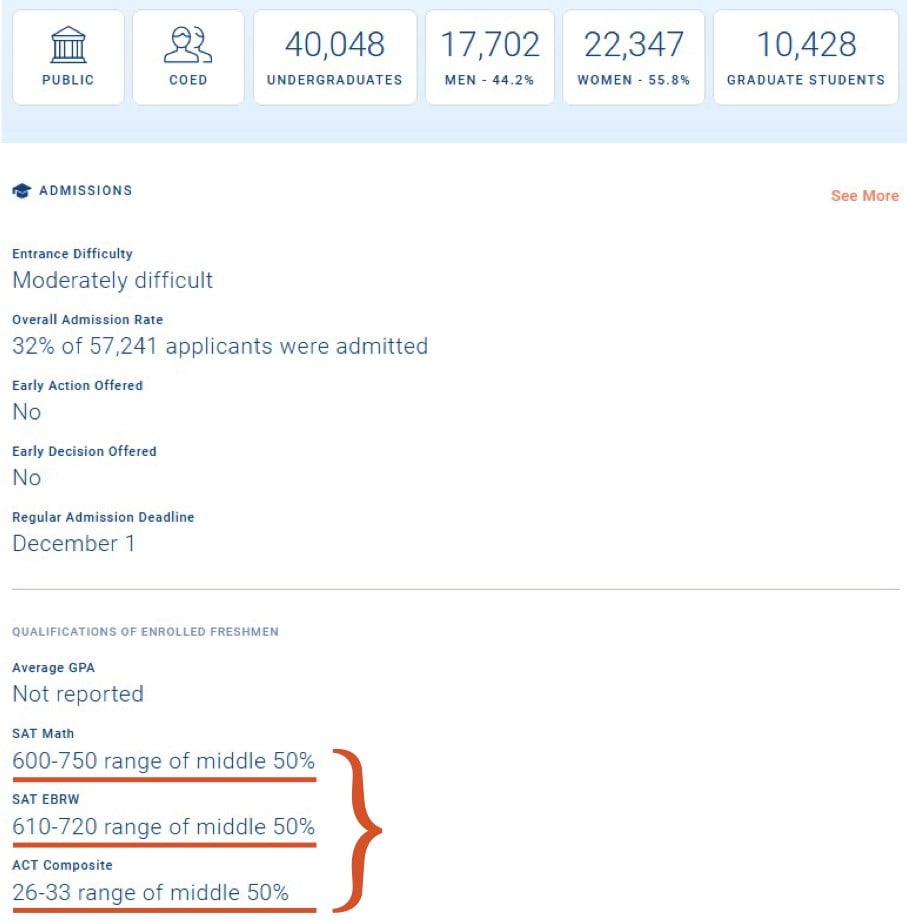
SAT and ACT test prep experts often say the first step in studying for the ACT or SAT is to find your “target” or “goal” score. To find your target score, look at the average test scores of recently enrolled freshmen at the colleges you plan to apply to. You can find these average scores in the College Profiles on CollegeData. The College Profile will report the “middle 50%” score range for the SAT’s English-Based Reading and Writing (EBRW) and Math tests, as well as the middle 50% composite ACT score, if the college reported it.

In the example below, University of Texas at Austin’s middle 50% ACT score range is between 26 and 33. This means 25% of enrolled freshmen at UT Austin scored below 26 on the ACT and 25% scored above 33. The remaining 50% of enrolled freshmen scored between 26 and 33. If you hope to be admitted to UT Austin, your target ACT score would fall at the higher end of this range and preferably above it.  

UT Austin's Average Test Scores

utaustin-admissions

Source: UT Austin's College Profile, 2020-2021. CollegeData.com

You’ll want to look at the middle 50% score ranges for each college on your list, select the highest range among your colleges, and shoot for a score near the top or above this range. In other words, if the highest ACT score range for all colleges on your list is 26 – 33, your target ACT score might be 33 or 34.

How to find ACT and SAT Score Averages on CollegeData

To find the average SAT and ACT scores of enrolled freshmen at the colleges you are interested in, look up the college’s College Profile on CollegeData, using College Search. On the College Profile, the middle 50% SAT and ACT scores are displayed under “Qualifications of Enrolled Freshmen” on the Overview tab.

Your target score might also be influenced by scholarships from private organizations or colleges, which sometimes have a minimum SAT or ACT score to qualify.

If you’re studying for the PSAT, keep in mind the average scores for National Merit Scholarship consideration. The qualifying scores change each year and differ by state. Check with your guidance counselor to find out the qualifying scores for your state.

2. Take Practice Tests to See Where You Stand—and How You’re Improving.

Taking practice SAT, ACT, or PSAT tests will help you determine your “baseline” score, and how far you need to go to reach your target score. Practice tests may also help you identify the areas of the test in which you are the strongest and weakest. It’s important to take an official practice test offered by the ACT or College Board (which administers the SAT and PSAT), because they are more likely to simulate questions you’ll see on the actual tests.

However, taking a practice test and noting your score isn’t enough. Kaplan test prep (the official ACT test prep organization) recommends that you go through every incorrect answer carefully to understand where you went wrong, familiarize yourself with the questions on the test, and analyze your results. You might find that you need to work on a certain type of question as opposed to an entire subject area.

3. Create a Test Prep Schedule

Test prep companies and private tutors have different advice and strategies for the number of study hours required to achieve different target scores. Regardless of your goals, a study schedule is critical. Your schedule might consist of a few hours of study a couple of days a week, or an hour every morning on weekdays with longer periods of study on the weekends. It depends on your goals, the number of areas you need to practice, and the time you have available to study.

It’s a good idea to set up a calendar mapping out your study plan up until your scheduled test day. It’s also important to take practice tests regularly to measure your progress and adjust your study time as needed.

Visit Kaplan’s website for a 3-month ACT test prep schedule or Khan Academy for a customized SAT practice plan.

4. Mix it Up

Use a variety of test prep resources. You might purchase a test prep book, subscribe to an SAT or ACT question of the day, watch YouTube videos, or download an SAT or ACT test prep app on your phone.

A virtual or in-person tutor, paid classes or an online study group are other ACT and SAT test prep options you might consider to add variety to your study routine. The ACT Academy and Khan Academy websites provide a variety of free SAT and ACT test prep options including videos, games and more.

Studying for the ACT or SAT can feel overwhelming, especially when your school year is already full with classes and activities. These tips should help set you off on the right study path and give you the best chance of achieving your test score goals. Good luck!


Tuesday, June 28, 2022

Applerouth Free July Webinars for Parents and Students


July offers another month of summer and some great opportunities to learn about: 
  • Mental Health & Coping 
  • Enhancing Your Writing Skills 
  • Transitioning to College 
And more! 

Get insights from Applerouth experts on a variety of subjects related to the well-being of your student. Please share these free webinars: All are welcome to attend!

Save Your Seat Today

How to Tame Anxiety and Build Motivation
Thursday, July 7 at 8:00pm ET / 5:00pm PT
Even the most intellectually gifted students can't achieve their potential without these 21st century skills. Learn how to equip your students for success in school and life.

How to Become a Stronger Writer
Monday, July 11 at 8:00pm ET / 5:00pm PT
To be a successful student, you have to be a strong writer. Unfortunately, writing is a tough skill to master and a lot of students don't get the instruction they need. It's not rocket science - you just need to know some basic principles to start improving.

SAT v ACT: The differences, timelines, and the expectations of colleges
Tuesday, July 12 at 8:00pm ET / 5:00pm PT
Join Applerouth Tutoring to learn about the SAT and ACT, as well as up-to-the-minute updates on both tests. You'll learn about the main differences between the two tests, how to decide which one is better for your child, when to take them, how much to prepare for them, and more.

Navigating the College Admissions Process 
Thursday, July 14 at 8:00pm ET / 5:00pm PT
The college admissions process should be a time of opportunity and new beginnings, but increases in competition and costs cause more anxiety than excitement. We will arm you with information to help you navigate the college admissions process with confidence.

Teens and Tech: Practical Tips for Parents
Tuesday, July 26 at 8:00pm ET / 5:00pm PT
 From setting boundaries to how tech use impacts your teen's school and family relationships, learn the facts and get practical tips to foster a healthy and manageable balance in your home.

Your Changing Role: How to Be a Great College Parent and Help Your Student Make a Successful Transition
Wednesday, July 27 at 8:00pm ET / 5:00pm PT
Join special guest speaker, Dr. Andrea Malkin Brenner, college transition educator, creator of the Talking College(TM) Cards, and co-author of "How to College: What to Know Before You Go (and When You're There)," for this practical session on things you can do to support your student's success in college while lessening your involvement in their daily lives as they become more self-reliant.


Tuesday, May 17, 2022

College Presentations from ACT - Check out These Tips from the Experts!

Your College and Career Planning Journey Starts Here!

View the following videos recorded at a recent live event, and read the questions and answers from each session. You'll learn from the experts how to prepare for college and career – from finding scholarships to transitioning to life on campus.


Wednesday, May 4, 2022

Three Spring and Summer Test Prep Tips for Juniors

by

illustrative image of a calendar with an important date on it
As the spring semester of your Junior year winds down, it’s still not too late to get going on the SAT or ACT.

While many high school juniors are wrapping up their SAT/ACT prep, many others are just getting started now. If you’re in the latter group, this article’s for you. Maybe you were busy with fall and winter sports, or your college application list has changed. Or your top choice is no longer test optional. 

Whatever the reason, there’s no reason to fret about getting on track to have SAT or ACT scores for your fall college applications. Here are three tips to help you get started and get on track.

Start by choosing between the SAT and ACT

As a current junior, you have roughly 6 to 8 months (depending on where you plan to apply and whether you plan to apply early decision or not) to study, take the test, and hit your goal score.

With the time remaining, it’s important to commit to one test or the other. The best way to determine which test is best for you is to take a practice test of each. If you took a PSAT back in October, that will give you a good sense whether the SAT is a good fit for you. Comparing your PSAT scores to practice ACT scores will give you an even better sense. 


You may also want to consider which math class you took in junior year. The SAT tops out at algebra 2 concepts, while the ACT includes many precalculus concepts. Additionally, the SAT is a test that focuses on your comprehension and application of concepts, while the ACT tests your ability to process a greater variety of concepts at a faster rate. If you prefer to think things through a bit more, you might find the SAT to be a better fit. On the other hand, if you thrive in a more fast-paced setting, you might prefer the ACT. 

For more information about the differences between the two tests, check out our comparison guide, here.

Set up a testing timeline

With a shortened timeline, it’s important to be strategic about when you’ll be testing. The SAT offers tests in June, August, October, November, and December. The ACT offers tests in June, July, September, October, and December. 

Typically, we advise that students plan for three testing dates. Our research shows that students typically get their highest score on their second or third official test attempt. Plus, multiple test dates confer the benefits of superscoring (combining your best section scores from multiple test dates for a higher overall score). If you hit your goal score early, all the better! But having a plan that includes multiple test dates will ensure you’re not scrambling.

As you select your test dates, it would be wise to plan to take one of the summer tests, which would give you an opportunity to retest in the fall. You should be aware that the July ACT is notorious for having limited testing locations as many testing sites are shut down for summer break. If you’re planning any early decision or early action applications, you’ll want to have all testing done by October. If you’re applying for standard admission, then you have until December to finish testing.

Maximize your summer-studying

Preparing for the SAT or ACT over the summer is a double-edged sword. On one side, you don’t have to worry about managing test prep with your schoolwork. You can study when you want and potentially where you want. 

The danger comes with having too much free time. It’s easier to get into full “summer mode” and fall into irregular sleep habits. If you’ve been staying up to 2 or 3 AM every night, it’ll be hard to align yourself to a test that starts at 9 AM. 

Rest is an important component of performance, so make sure that you guide yourself to sensible sleeping habits two weeks before the test date. A great way to get into a summer study rhythm is to schedule your test prep study time in the morning. One hour of practice first thing will do wonders for your performance on test day.

Wednesday, April 20, 2022

What Are Your Test Prep Options?

Source: CollegeData.com

 If you’re wondering how to study for the SAT or ACT, you are not alone. Here are a few test prep options to explore to help you create a SAT or ACT study plan that is right for you.

Although many colleges and universities have become test-optional, taking the SAT or ACT may still be important, depending on your goals or college list. In addition to the fact that many colleges still require test scores, test-optional schools will consider your scores if you submit them, and high scores may enhance your academic profile.

However, preparing to take the SAT and/or ACT can be one of the more stressful parts of applying to college and many students don’t know how or where to begin. Fortunately, a wide range of test prep resources and study plans are available – from in person and online courses to mobile apps to printed books and guides. Here are a few strategies to consider.

Practice Tests

For many students, the best way to prepare for the SAT and ACT is to take practice tests at home. Free practice tests for the SAT are available from Khan Academy, which partners with the SAT’s parent organization, the College Board, to provide SAT prep. Free practice tests for the ACT are available from the ACT website and through its partner Kaplan.

Many test prep books include sample tests with answer keys. Books are usually updated annually and provide analysis of questions and test-taking strategies. While you can purchase new or used test prep books from a bookstore or an online retailer, it’s also a good idea to check with your school or public library to see if these books are available to borrow.

Study Groups

Education research has shown that studying with a group can be more effective than studying alone. Joining a weekly SAT or ACT study group can introduce you to new study and test-taking strategies, provide support, and help you stick to a study schedule.

For tips on starting and running a study group, visit the College Board website. “Teaching” the material to others is another way to retain it for yourself, so consider offering to tutor a classmate or a friend.  

Resources on the ACT/SAT Websites

The ACT and SAT websites each offer test prep resources and advice. The ACT website offers video lessons, online self-paced courses, and one-on-one online tutoring. Fees for these resources range from $99 to several hundred dollars. There are some free resources as well, such a free ACT practice test and study guide, and the ability to view one online class for free.

The College Board, through the Khan Academy, provides a variety of free SAT test prep resources, such as practice tests, diagnostic quizzes and numerous videos that hone in on different types of questions and how to approach them. You can also create your own test prep schedule on the site and set up email reminders to keep you on track.

Commercial Test Prep Classes

A number of companies and tutoring firms offer formal test prep classes both in person and online. Courses range from one-day seminars to weekly classes held over several months. These are often, but not always, taught by professional testing tutors or people who have scored in the 90th percentile on the tests and include additional study guides, activities, or materials.

Typically, in these courses, your instructor will walk you through the entire test, provide test-taking strategies, explain test questions, and help you identify your strengths and weaknesses. These classes can cost anywhere from hundreds to thousands of dollars. If you’re taking the test a second time, some companies guarantee a score improvement or your money back.

Test prep classes and review sessions are also offered by some high schools, community colleges and public libraries. It's worth popping by your counselor's office to see what your local options are.

APPS And YouTube Videos

While mobile apps enable you to study for the ACT or SAT anywhere, most SAT and ACT test prep experts caution against relying on them as your only study source. Still, apps can supplement other prep you’re doing, help you track your progress, and enable you to study anywhere at any time.

Here are just some of the SAT and ACT study apps currently available.

You’ll also find a multitude of videos covering various aspects of the SAT and ACT on YouTube provided by a wide range of instructors. The ACT, College Board, Kaplan, and Khan Academy also have their own YouTube channels. You probably won’t want to rely on YouTube as your sole source of test prep information. However, if you have a specific question or problem you want to work on, or you just want to change things up with your test prep routine, YouTube might be a good option.

Private Coaches and Tutors

A private test prep coach or tutor can be an expensive option. Private tutors can charge anywhere from $45 - $200 an hour or more. But, a tutor will focus exclusively on the areas where you need to improve, and tailor the instruction and practice to your individual goals. You may be able to find free or inexpensive tutoring through your high school, youth center, or other organization.

Test Prep Only Goes So Far

Test prep can help you practice your skills, refresh your knowledge, and become more comfortable with the tests. But test prep will not teach you the fundamental skills and knowledge that you should have acquired during high school. Be careful that extensive and obsessive test prep doesn’t distract you from your other commitments, such as your school work and extracurricular activities.

Should You Take a Test Multiple Times to Improve Your Score?

Test prep experts disagree on how many times a student should take the ACT or SAT. Some say the most significant improvement usually comes after the second attempt at the official test. Others say improvement plateaus after the third attempt. If you are happy with your score after the second try, you might want to relax and move on to your other college admission tasks.

Become a BigFuture Ambassador

What Ambassadors Do?   Connect with Each Other Once a month, meet on Zoom for an hour in the evening. Betwee...