Thursday, January 18, 2024

Hardest AP Classes: What Are They And Should You Take Them?

 By Ameer Drane (College Essay Guy Blog)

Challenging. Difficult. Hard. You know what those words have in common? They’re all subjective. So, when you ask, “What are the hardest AP classes?” we have to be honest and give you what might seem like a boring answer: it depends. What’s challenging for you might be a piece of cake for your classmate. 

So, here’s a better question: “How do I choose or avoid (depending on my goals) the AP classes that will be the most difficult for me?” And although we can’t give you the answer (only you can do that!), we can help point you in the right direction by sharing information on: 

  • The 2022 AP exam pass rates

  • Student reviews of the hardest AP classes and exams

  • What to consider when evaluating the difficulty of an AP class

  • Answers to common questions about how to choose the best AP classes for you

And those are exactly the topics we’ll cover in this blog post. So, let’s jump right in! 

Hardest AP exams by pass rate

Heads up: AP exam pass rates aren’t a conclusive way to determine the difficulty of an AP class. But exam scores can give you an idea of which AP classes might have challenging material to master. So, we’ll start there.

According to data from the College Board (the organization behind AP curriculums and exams), the following exams had below a 60% pass rate (meaning below a score of 3):

  • AP Calculus AB

  • AP Chemistry

  • AP Economics—Macro

  • AP Economics—Micro

  • AP English Language

  • AP Environmental Science

  • AP European History

  • AP Government & Politics United States

  • AP Human Geography

  • AP Latin

  • AP Physics 1

  • AP Psychology

  • AP United States History

Is an exam pass rate a direct reflection of the difficulty of an AP class? Not necessarily. If you take a look at our post on the easiest AP classes, you’ll see students frequently say that AP Environmental Science is ‘easy’ despite the exam pass rate for this class being one of the lowest. 

What causes this discrepancy? We’ll answer that question in a minute. 

But first, we’ll indulge your curiosity for data. Here’s a full list of all the 2o22 AP exam pass rate percentages and median scores.

Student Score Distributions for May 2022 AP Exams

AP Subject Pass Rate
(Exam Score of 3+)
Median Score
AP Art & Design: Drawing 88.3% 3.54
AP Art & Design: 2-D 86.6% 3.43
AP Art & Design: 3-D 73.6% 3.12
AP Art History 61.5% 2.99
AP Biology 67.9% 3.11
AP Calculus AB 55.7% 2.91
AP Calculus BC 76.9% 3.68
AP Chemistry 54% 2.73
AP Chinese Language 86.9% 3.97
AP Computer Science A 67.5% 3.2
AP Computer Science Principles 63.5% 2.91
AP Economics - Macro 51.8% 2.71
AP Economics - Micro 59% 2.93
AP English Language 55.7% 2.83
AP English Literature 77.9% 3.31
AP Environmental Science 53.8% 2.79
AP European History 58.9% 2.95
AP French Language 71.6% 3.16
AP German Language 65.5% 3.13
AP Government & Politics Comparative 70.5% 3.14
AP Government & Politics United States 48.6% 2.58
AP Human Geography 53.2% 2.7
AP Italian Language 70.5% 3.26
AP Japanese Language 75.5% 3.65
AP Latin 57% 2.77
AP Music Theory 61.9% 3.03
AP Physics 1 43.3% 2.47
AP Physics 2 69.7% 3.14
AP Physics C E&M 69.4% 3.44
AP Physics C Mechanics 73.4% 3.41
AP Psychology 58.3% 2.71
AP Research 82.7% 3.3
AP Seminar 82.6% 3.19
AP Spanish Language 81.7% 3.54
AP Spanish Literature 64.2% 2.91
AP Statistics 60.5% 2.89
AP United States History 48.2% 2.57

How to determine which AP classes will be “hard” for you

What may be challenging for one person may be easy for another. However, some key considerations include the following:

How much you already know about the subject 

Whether it's AP Art History or AP Statistics, if you've never studied the material before, then it's likely to be a challenge. Now, this doesn't mean you can't excel in the class—it simply means that you will have to put in extra time and effort. But if you have prior exposure to the material, you already have an advantage. 

For example, few students will mention AP Japanese Language as one of the hardest AP classes. And you might even think the class is easy since the exam pass rate is 75.5%. But if you have never studied Japanese, you'll probably find it at least a tad more challenging than, say, AP English Literature.

It's also important to note that the exam pass rates and student reviews for AP language classes can be misleading. Why? Some students are native speakers of these languages. Similarly, some students have exposure to the language outside the classroom. That's why, if you remove those students from the data, the exam pass rate for AP Japanese Language drops from 75.5% to 53.5%. A similar drop occurs for nearly all the other AP language exams.

How interested you are in the subject 

If you find a class boring, it's going to be much more challenging to stick with it and learn the material well than if you are genuinely interested in the subject. On the other hand, a tough yet interesting course could become the easiest AP class for you to give your best effort.

For example, if you're interested in the physical sciences, a class like AP Chemistry could be one of your favorite classes—even if your classmates think the course is brutal. Similarly, you might find a class like AP Government & Politics Comparative difficult because the material bores you to tears—even if your classmates think the course is easy.

How well your teacher covers the AP curriculum 

A good teacher will have a deep understanding of the content and curriculum of the course and also effectively convey the material in a way that is engaging and understandable. This can significantly affect how well you understand the material and perform on the exam.

The opposite is also true. A bad teacher can make even the “easiest” AP class feel frustrating and overwhelming, especially if they lack effective teaching strategies to help you grasp and retain complex concepts.

How many AP classes should I take?

There is no definite answer for how many AP classes you should take. The decision should come down to your individual goals, strengths, and interests.(Side note: some schools are even dropping AP classes entirely, and others have restrictions on whether or how many AP classes students can take.) Still, there are a few key considerations to keep in mind.

Before deciding on any course load, you should ensure you fully understand the requirements and expectations of each AP class you’re considering. Will you have the time and energy to commit fully to multiple AP classes? If not, starting with one or two AP classes or exploring ways to improve your time management skills is best. 

You’ll also want to consider the competitiveness of the colleges you’re applying to. AP classes can help demonstrate to admissions officers that you can handle a challenging college course load. 

For some students, one or two AP classes may be sufficient to demonstrate their academic abilities and readiness for college-level coursework. However, other students may find they thrive with a rigorous class schedule and would benefit from taking more AP classes. 

Which AP classes should I take?

Ultimately, it's important to be thoughtful and strategic when choosing AP classes. You should consider your interests and strengths, not just the potential benefits for your college applications.

For example, if you're interested in art, you might consider taking AP Art History or one of the AP Art & Design classes. Similarly, suppose you excel in math and science. In that case, you may benefit from taking AP Physics 1 or AP Calculus BC—even if students generally consider these classes to be two of the hardest AP classes.

You should also consider which classes will support your intended major on college applications. For example, if you plan on applying as a pre-med student, consider taking AP Biology or AP Chemistry classes. College admissions will view your participation in these classes as an indication of your academic interests and aptitude, which can help set you apart from other applicants.

Can I self-study for AP exams?

While it is possible to self-study for AP exams, this can be challenging. To successfully self-study for AP exams, you need to be highly motivated and disciplined to stay on track with the curriculum. You’ll also need to be able to juggle self-study with your other academic and extracurricular commitments.

How AP grades and test scores affect college admissions

Many colleges pay special attention to the difficulty of your high school course load. For example, if you look at the MIT admissions requirements, you'll see they regard the rigor of your high school coursework as "Very Important." Why is course rigor so important? Because it shows admissions you’re willing and capable of managing a demanding college class schedule. 

 So, if you’re considering applying to schools with highly competitive admissions like MIT, you should take at least a few AP classes. Of course, you can also demonstrate academic rigor through other means, such as taking college-level classes online or at a local community college. Still, the benefit of AP classes is that their rigor is highly regarded and respected by admissions officers across college campuses.

On the other hand, if you’re thinking of applying to colleges with less competitive admissions, AP classes might not be as important. However, the other benefit of taking AP classes is that you may be able to receive college credit if you receive a passing grade on the AP exam. Policies for assigning credit for AP exam scores vary from college to college. But, if you attend a college that gives credit for passing AP exams, you’ll begin college with a head start toward graduation. 

Final thoughts

There’s no way of creating a universal list of the easiest or hardest AP classes. There are too many subjective factors to consider. Instead, use what you’ve learned here to pick the AP classes you’re most interested in that also support your college applications. 

Also, remember that AP classes aren’t the only way to prepare for college applications! Make sure to also focus on things like writing exceptional application essays, picking the best teachers to write your recommendation letters, and excelling in your extracurricular activities. 

If you need support with any of that, check out our College Application Hub! There, you’ll find free resources and guides that walk you through the entire college application process.

Special thanks to Ameer Drane for writing this blog post.


Engineer Girl Scholarship Opportunity

 EngineerGirl, a program of the National Academy of Engineering designed to bring national attention to the exciting opportunities engineering represents for girls and women, hosts an annual writing contest with prompts about engineering and its impact on our world. The 2024 contest asks students to write a piece exploring the lifecycle of an object they use in their daily life. The contest is open to students of any gender in grades 3-12, and the top prize is $1,000. 

The deadline is Feb. 1, 2024.

 Learn more here.

Wednesday, January 17, 2024

College Application & Admissions Timeline (AKA What Should I be Doing Right Now?)

 From the College Essay Guy

This college admissions timeline tells you what tasks to prioritize each year of high school in order to prepare for college.

Inside, you’ll find tons of resources for finding out how long the admissions process takes, when you should begin preparing (hint hint, now), and even when to take those pesky standardized tests.

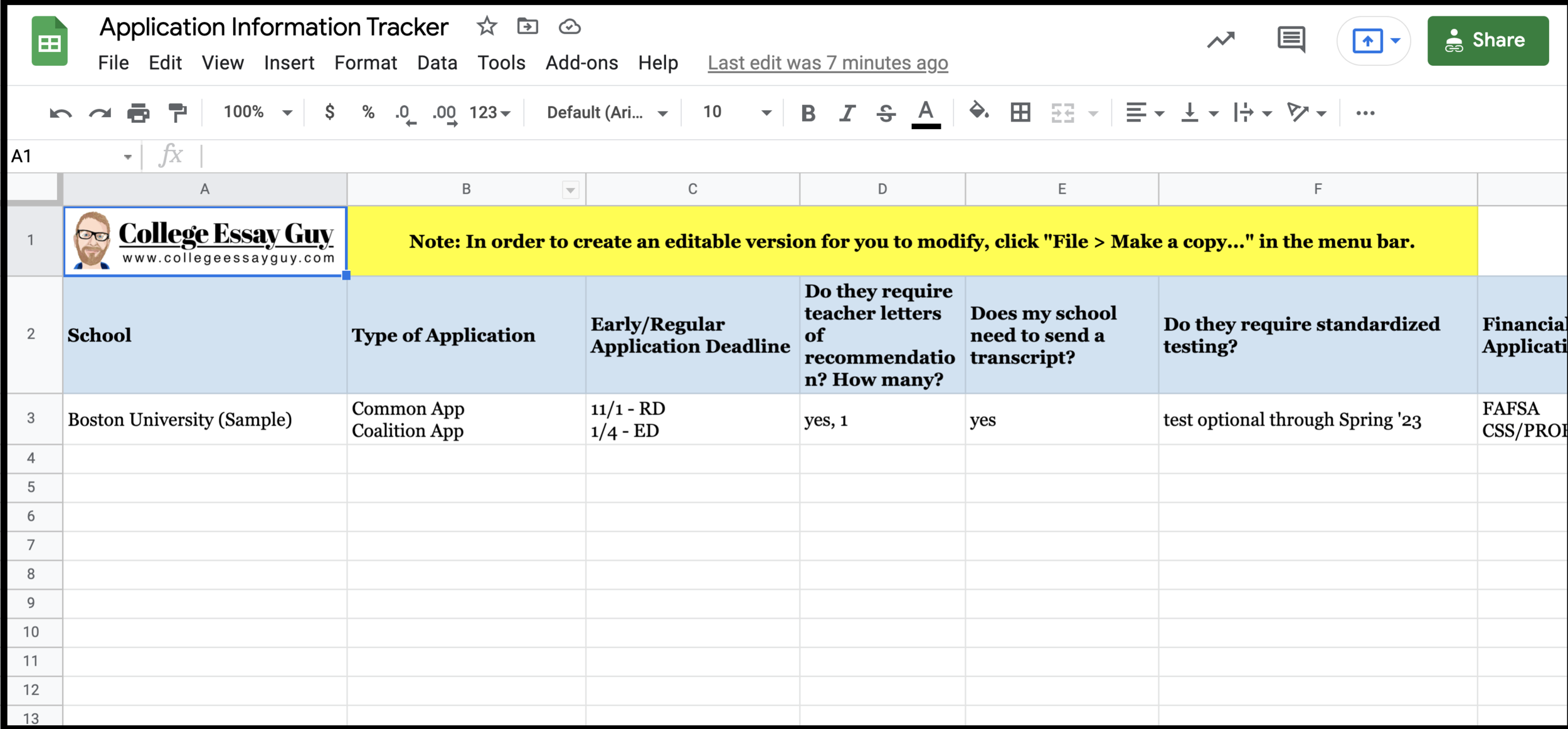
Click here to download our simple college application information tracker

9th grade Timeline

  • Do the Values Exercise to determine what’s important to you.

  • Take a personality assessment to learn more about your strengths, challenges, and communication and learning style.

  • Explore and engage with extracurricular activities (e.g., clubs, sports, community service, fine and performing arts, work, and other in-­or out-­of-­school activities) that align with  your values and strengths

  • Create an activity log to track all your extracurricular activities, summer experiences, academic honors, and other achievements.

  • Develop your time management and study skills.

  • PSAT: Some high schools allow you to take the October PSAT as a freshman.

  • Take an interest assessment to explore possible college majors and careers. 

  • Plan your high school classes using insight from the bullet above.

  • Meet with your school counselor to explore clubs, classes, and discuss course selection. Start building a relationship with them by doing this regularly.

  • Parents: Start exploring how to pay for college.

  • Athletes: Familiarize yourself with the NCAA and NAIA athletic recruiting requirements. 

  • Plan a summer experience that helps you explore a passion or interest.

  • Summer reading: Expand your vocabulary and your world.

10th grade timeline

  • Do the Values Exercise to see if your ever-evolving self has new priorities. If they’ve changed, assess whether you want to change your current activities so they align with your values.

  • Continue participating in non-­academic extracurricular activities. See if you can deepen your involvement or take on a leadership role in the activities you’ve already been doing. Or step outside your comfort zone and try something new.

  • Update your activity log.

  • Stay focused on keeping your grades up--this year’s grades are important to college admissions officers. 

  • If your school offers higher-level (honors or AP) classes, challenge yourself academically by taking one a higher-level (honors or AP) class or two (honors or AP classes), in areas that you’re interested in.

  • PSAT: Some high schools allow you to take the October PSAT as a sophomore.

  • Attend a local college fair.

  • Meet with your school counselor at least once a year to discuss course selection. Continue building this relationship by asking lots of questions about new courses and suggestions for ways to develop your interests..

  • Parents: Continue researching how to pay for college and set up a college budget.

  • Visit a college or two locally or while you're on vacation.

  • Read more about possible college majors and careers to better plan out your high school classes.

  • If you think you may play Division I or II sports in college:

  • Testing 

    • If you're taking an AP class this year, consider sitting for the AP exam (May). If you're concerned about your readiness, check in with your teacher for advice. 

    • At the end of the school year, take a practice ACT and SAT to determine which test may be better for you, then set up a testing timeline.

  • Summer reading: Continue expanding your vocabulary and your world.

  • Continue exploring your interests during the summer. This could be through a job, internship, volunteer experience, or self-designed project.


11th grade Timeline

FALL

  • Check in with the Values Exercise. Has anything changed?

  • Stay consistent with your non-­academic extracurricular activities if your values and priorities haven’t changed. If they have, try something new. Continue to look for ways to explore and deepen your interests in these activities. Try a leadership role if you haven’t already.

  • Continue to update your activity log.

  • Start your college search by attending a local college fair and a few college admission rep presentations at your high school (if they are offered).

  • Explore your college interests by sorting the college criteria on www.Corsava.com. Then use those preferences to searches for a few college matches.

  • Start a preliminary list of colleges to visit using the results of your college match searches. Have a family meeting to block out dates for college visits throughout junior year.  

  • Keep your grades up. Junior year grades are the last ones some schools will see before making an admissions decision.

  • Take an aptitude or career assessment such as YouScience to learn more about your interests and strengths, which will change as you grow and learn.

  • Continue challenging yourself academically with higher level AP or honors classes.

  • Schedule a meeting with your school counselor to discuss the colleges you are interested in. Tell them about your college preferences and ask for their suggestions of colleges that might be a good fit for you. Continue to develop your relationship with your counselor.

  • Testing

  • Athletic Recruitment

    • Double-check that  your classes meet the NCAA Clearinghouse requirements 

    • Complete online athletic recruitment forms for each college you're considering. You'll find these on the college's website under "athletics."

    • Once you’ve completed the online recruitment forms, make your sports resume and recruitment videos.

    • Spread out your correspondence with coaches by sending the resumes and video a few weeks after you complete the online forms.

  • Fine & Performing Arts Students

    • Sign up for Performing & Visual Arts College Fairs.

    • Create an admissions requirements spreadsheet for fine and performing arts programs.

    • You most likely need to create a portfolio and audition materials, so spend junior year working on pieces.

WINTER & SPRING

  • Investigate summer experiences.

  • Register for senior year classes. Remember colleges will want to see a strong senior year course load including five academic core classes.

  • Continue visiting colleges. Use local colleges to sample certain types of schools (single-sex, small liberal arts, larger university, etc.)

  • Start building your college list based on your values and your research.

  • Start researching scholarship opportunities.

  • Complete the Letter of Rec questionnaire and request letters of recommendation from two academic teachers from junior year.

  • Testing

    • Select testing dates. Most likely your first ACT or SAT will take place between December and May.

    • Take the AP/IB exams in May.

  • Athletes

    • Send your sports resume and video to college coaches and fill out the athletic recruitment surveys on the college websites.

  • Fine & Performing Arts Students

    • Explore how the audition and portfolio process works for college admission.

    • Build your portfolios and audition videos.

  • Set up a meeting with your school counselor to ask questions about college choices, your senior year schedule, testing, and anything else you're curious about.

SUMMER

  • Participate in summer experiences (research, reading, internships, fun stuff).

  • Refine and finalize your college list. Be sure it reflects a balance of admission probabilities (likely, possible, and reach schools).

  • Research the type of applications required for each school on your list, as these vary.

  • Write your Common Application personal statement

  • Complete the Common Application.

  • Visit more colleges.

  • Research the admission requirements and deadlines for schools on your list and create a spreadsheet to organize information. Research to see if an interview is offered or required at each school.

  • Create a scholarship spreadsheet to list deadlines and requirements.

12th grade Timeline 

AUGUST & SEPTEMBER

  • Confirm your final college list, application deadlines, and requirements.

  • Write your college-specific supplemental essays.

  • Ask an expert outside reader to review your Common Application and personal statement.

  • Continue to research scholarships, adding requirements and deadlines to your list.

  • Set up on-campus or local rep interviews with colleges.

  • Check in with your recommendation writers. Update your Letter of Rec Questionnaire and ask for a letter of recommendation from your school counselor.  

  • Apply to scholarships throughout the school year.

  • Parents: Start preparing financial aid paperwork and develop a deadlines list. 

SEPTEMBER - NOVEMBER

  • Complete and send out all EA and ED applications no later than late October. (These deadlines are typically around November 1. )

  • Many portfolio-based arts programs have December 1st deadlines. And some universities require submission by December 1st to be considered for scholarship opportunities. Schedule a meeting with your school counselor to review your college list to get his or her feedback and review your application deadlines, and ask any questions you may have.

  • Attend high school presentations and programs.

  • Apply for financial aid using the FAFSA and CSS/PROFILE (if required).

  • Completed final college visits.

  • Send test scores to your colleges after checking whether they allow self-reported scores.

  • Ask your school counseling office to deliver letters and transcripts to colleges. 

DECEMBER

  • Regular Decision (RD) deadlines are typically around January 1. Complete and send out all RD applications no later than mid-December. Give yourself a relaxing holiday break by completing your applications before November 15.

JANUARY - MARCH

  • January: If deferred, send an email to your region/state/country admissions representative. Reaffirm your interest in the school and offer any updates (activities, achievements, awards, etc).

  • Wait for application decisions.

MARCH - APRIL

  • Colleges have until April 1 to release decisions.

  • Plan visits to accepted colleges, if needed, in order to make your final college choice.

  • Attend local admitted student events when possible.

  • Evaluate financial aid packages and scholarship offerings to figure out how to pay for college.

  • Students need to enroll and submit a deposit by May 1.

MAY

  • Take AP/IB exams.

  • Notify your school counselor of your college decisions and scholarship opportunities.

  • If you've been waitlisted, this is a good time to send a)your “I'd like to stay on the wait list" form and b) the email to your designated admissions rep which states your interest in the school and offers updates (activities, achievements, awards, etc).

  • Sign-up for campus housing if you plan to live on campus.

JUNE - AUGUST

  • Continue saving for college.

  • Check your email for waitlist notifications.

  • Attend orientation sessions.

  • Sign up for meal plans and register for classes.

  • Find out what you need for your dorm and classes, and go shopping.

  • Contact your future roommate(s).

  • Make travel and move-in arrangements.

  • Set up a bank account on or near ­campus.

  • Continue applying for scholarships.

  • Set up a meeting with an academic advisor at your college to plan your classes.

To learn more about how to have an amazing pre-college summer, click here!


How many AP classes should I take?

They're not required. But if you want your transcript to stand out to college admissions officers, AP classes are definitely a good idea. Of course, that's only true if you take AP classes that you can get good grades in.

But what are AP classes? Are they the same as college classes? Do you have to take an AP class to take an AP exam? If AP classes are not required to apply for college, why consider taking them? And, if you do, how many should you take?

Good questions! And, in this blog post, we're sharing all the information you need to determine whether one, two, several, or none is the right number of AP courses for you.

Sound good? Good. Let's get started!

What are AP classes?

AP classes, or Advanced Placement classes, are advanced-level subject courses that give high school students the opportunity to challenge themselves by taking classes with a rigor similar to college classes.

The College Board (the organization behind the SAT) is responsible for designing the AP curriculum and overseeing the exams given every year in May to students worldwide.

Your school likely won't offer every AP class that's available. But here's the full list of AP courses currently offered by the College Board.

Arts

  • AP 2-D Art and Design

  • AP 3-D Art and Design

  • AP Drawing

  • AP Art History

  • AP Music Theory

English

  • AP English Language and Composition

  • AP English Literature and Composition

History and Social Sciences

  • AP Comparative Government and Politics

  • AP European History

  • AP Human Geography

  • AP Macroeconomics

  • AP Microeconomics

  • AP Psychology

  • AP United States Government and Politics

  • AP United States History

  • AP World History: Modern

Math and Computer Science

  • AP Precalculus (New for 2023-24)

  • AP Computer Science A

  • AP Computer Science Principles

  • AP Calculus AB

  • AP Calculus BC

  • AP Statistics

Sciences

  • AP Biology

  • AP Chemistry

  • AP Environmental Science

  • AP Physics 1: Algebra-Based

  • AP Physics 2: Algebra-Based

  • AP Physics C: Electricity and Magnetism

  • AP Physics C: Mechanics

World Languages and Cultures

  • AP Chinese Language and Culture

  • AP French Language and Culture

  • AP German Language and Culture

  • AP Italian Language and Culture

  • AP Japanese Language and Culture

  • AP Latin

  • AP Spanish Language and Culture

  • AP Spanish Literature and Culture

There are also the AP Seminar and AP Research courses if you enroll in the AP Capstone Diploma Program.

Should I take AP classes?

The short answer: more selective colleges generally care about AP classes. So, even though you don't have to take AP classes to apply for college, depending on your college list, you probably still should (but a heads up that AP policy varies from school to school—some schools allow students to take anything they want, while others have various rules and restrictions, and some schools have chosen to drop AP classes entirely). It's usually a good idea to discuss what fits you best with an advisor or counselor at your school.

The more detailed answer involves several factors to consider:

Show college admissions you can excel in challenging courses

The “rigor” of your high school coursework is one of the most important factors that college admissions officers consider when reviewing your college applications. For example, look at the MIT admissions requirements or UCLA admissions requirements: you'll see both colleges believe the rigor of your secondary school record to be "very important."

Why do colleges care so much about rigor? Because if you can do well in rigorous classes while in high school, college admissions officers feel more confident that you can succeed in college. The more challenging courses you've taken, the better. So, if your school offers several AP courses and you choose to take none, you may be at a disadvantage compared to other students who have taken AP classes. But note that if your school doesn’t offer any AP courses, you will not be expected to take them. (Side note: if that’s the case, it may be useful to clarify in your Additional Info section)

Show fit for your intended major or pre-professional programs

AP classes are also a great way to demonstrate your interest in whatever subject you list as your intended major on your college applications. For example, let's say you want to enter a pre-med program or BS/MD program and major in Biology. If you take AP Biology and do well on the AP exam, college admissions will believe you have a strong foundation in Biology and that you're more likely to be able to handle the challenging coursework required for a pre-med student.

Develop college-level academic skills

Many students worry about whether they'll be able to handle the increased expectations and workload of college classes. AP classes can help you develop the time management and study skills you'll need in college. AP classes also give you the opportunity to build your critical thinking and analytical skills and deepen your understanding of complex content and concepts.

Bonus: sometimes, college credit

AP classes also offer the opportunity to take an exam at the end of the course, which can earn you college credit or advanced placement in some programs. But the exact score and requirements for college credit will vary depending on the school and program. Typically, you'll need to score a 3 or higher on the exam to receive college credit.

Some colleges don't offer any credit for AP classes but will use your scores to place you in higher-level courses or exempt you from certain requirements. For example, if you take an AP English course and score high enough on the exam, you may be able to earn college credit or skip a lower-level writing course. Because things vary from school to school, you’ll want to double check as you build your college list.

What are AP exams?

AP exams test you on the material you learned over the course of your AP classes. Each exam typically lasts 2-3 hours and can include multiple choice, short answer, and essay questions.

When are AP exams?

AP exams are offered once per year during May and June, typically lasting for two to three weeks. You can find the most recent exam date schedule here.

Can I self-study for an AP exam?

Yes. You can self-study for an AP exam even if you haven't taken the AP class. Self-study can be a great option if your school doesn't offer any AP classes or doesn't offer an AP subject that you're interested in. It's also a good choice if you already have a strong background in a particular subject.

The biggest issue with self-study for an AP exam is that you might have to learn a lot of complex material on your own in addition to the rest of your high school coursework. And self-studying is not a good idea if it will cause your grades to slip.

If you do decide to self-study, it's also essential to use an official AP curriculum or test practice book to guide your studies. Why? AP exams may expect you to answer the questions in a particular way based on what's taught in the standard AP curriculum.

A great alternative to self-study is to take an online AP prep course. These courses often include instructional videos, practice exams, and study guides tailored specifically to each AP subject. 

We don't have any official recommendations for these online courses. But here are two examples of free and paid options:

Unfortunately, there isn't a one-size-fits-all answer to this question. The right number of AP classes for you will depend on various factors, such as your academic strengths, study habits, learning style, and college list.

Some things to consider include:

  • Can you handle the increased workload of AP classes?

  • Do you have good study habits and time management skills that will allow you to succeed in AP classes and on exams?

No matter whether you take AP courses, or how many, the most important thing is to choose the classes that are right for you and work hard to excel in them!

Another factor to consider, as mentioned earlier, relates to your college list: Are you hoping to apply to highly selective (aka “highly rejective”) schools?

If not, then you can mostly focus on the factors just mentioned.

But if so, those schools will consider the “rigor” of your course load—did you generally take the toughest classes available to you? If you maintained a high GPA but did so by avoiding the harder courses your school offers, that will tend to hurt your chances with selective schools.

So… are AP classes worth it?

If you're applying to competitive college programs and have the time and motivation to take on the challenge, AP classes can definitely be worth it. They can help you prepare for college, build your academic confidence, and give you a leg up on admissions.

On the other hand, if you're struggling to balance schoolwork with other commitments or are simply not interested in AP courses, there's no need to feel pressured to take them. There are plenty of other ways you can prepare for college.

Preparing to take an AP exam soon? Check out these resources:

Tuesday, January 16, 2024

Spring College To-Do List for Juniors


From College Data

The second half of junior year is when applying to college starts to get real. Here are some things you can do this semester to make sure you’re ready to apply this fall and minimize stress senior year.

1. Make a First Pass at a College List

Whether you’ve been researching colleges since you were a ninth-grader or you’re at the beginning of your college search, spring of junior year is a good time to research colleges for your college list. Most counselors recommend creating a “balanced list” that includes some schools that are “reaches”, some that are “maybes”, and a few that are “good bets.”
  • Reaches are schools where your GPA, test scores and class rank fall at the lower end of, or below, the average range of the most recently admitted freshman class. You’ll find the average test scores and GPAs for more than 2,000 colleges in CollegeData’s college profiles, which you can access with College Search. A reach can also be a school that is highly selective, such as Ivy League and other highly competitive schools.
  • Maybes are schools where your GPA, test scores, and class rank fall within the average range of the most recently admitted freshman class.
  • Good Bets are schools where your GPA, test scores, and class rank are above the average range of the most recently admitted freshman class.
Regardless of whether the colleges you are considering are reaches, maybes or good bets — make sure they are schools you'd be happy to attend and are colleges you and your family can afford. Don't forget to take financial aid into account when looking for affordable — or financially friendly — colleges.  
CollegeData’s College Chances tool can help you identify reaches, maybes and good bets based on your current GPA, test scores, and other factors.

2. Get involved with an activity and consider a leadership role

Staying involved in your extracurriculars can be challenging junior year, especially if you are taking challenging courses. But, your activities and extracurriculars can demonstrate your interests outside of class and can provide an opportunity for you to show leadership. If you haven’t participated in any activities, now is the time to get involved — whether it’s with a club, a team, a community organization, or your church.

You don’t have to be the president of your club or team captain to demonstrate leadership, either. Organizing food drop-offs for people in your community, starting fundraisers, or planning events or strategies for the coming year to help keep your team or club going also show creativity and leadership.

3. Go on In-person or Virtual College Visits

If possible, go on a few college visits, even if it's only to some campuses in your local area. During the COVID-19 pandemic, many colleges cancelled in-person tours but expanded their online and virtual offerings to help students experience their campuses remotely. At most colleges, you’ll find virtual tours that take you around campus and into residential halls, classrooms, and more. 

You can also use social media to research colleges you are interested in or are considering or set up telephone or videoconference calls with admission officers from those schools. For more ways to learn about colleges without visiting, see Visit a College Without Stepping on Campus.

Most colleges are once again holding in-person tours, and your spring break can be a convenient time to attend these. Before you go, review these tips for making the most of a college visit and questions to ask

4. Attend a college fair

College fairs (virtual and in-person) can be a great way to learn about colleges and connect with admission reps. It’s important to plan ahead for a college fair so you can make the most of your time. Check out these do’s and don’ts for college fairs for some tips.

For more information on upcoming college fairs, visit the NACAC college fairs website, or consult the College Fair Guide for a list of fairs in your region. 

5. Choose Teachers to Write Your Recommendation Letters

Many college applications require one or more letters of recommendation from teachers and/or guidance counselors. Be sure you know which colleges on your list require recommendation letters and from whom they require them. Some colleges ask for letters from more than one teacher as well as a counselor. Many teachers prefer that you ask them for a recommendation before the end of your junior year so they have the summer to work on it. 

For tips on choosing whom to ask to write your recommendation letters, see How to Get the Best Letters of Recommendation.

6. Consider Signing Up for the SAT OR ACT

Although thousands of colleges have adopted test-optional admissions, counselors still advise students to take these tests, especially students who are applying to highly selective schools. “Test-optional” colleges will consider your test scores if you submit them, and if you score well on the SAT or ACT, submitting scores can work in your favor. If you are unable to take the SAT or ACT, or you don’t do as well on the test as you hoped, you can choose not to submit your scores and focus on other parts of your application. 

7. Learn About the Financial Aid Process

If you plan to apply for financial aid, it’s a good idea to learn about the types of aid available and how to apply for it. Start learning about how colleges figure cost of attendance, the concept of net price, and get familiar with the application forms students use to apply for financial aid: the Free Application for Federal Student Aid (FAFSA) and the CSS Profile.

8. Discuss College Affordability with Your Family

It’s a good idea to start discussing college finances with your family — and even more important during uncertain economic times. It's important to consider how much you and your family are able and willing to spend for college, whether loans are an option, and ways you can make the cost manageable. For advice on how to start this conversation, see How to Talk with Your Parents About Paying for College.

9. Get Advice from High School Seniors

The seniors you know have just completed the long and sometimes grueling college application process. Ask them what advice they can share with you. What would they do differently if they could apply to college all over again? See CollegeData’s Road to College Student Stories for advice from real college students.

10. Line up support

It’s important to get support during the college application process — and the earlier the better. If you haven’t done so already, connect with your high school guidance counselor and let them know your interest in applying to college. You also might want to explore other resources, especially if your school’s counseling staff is limited. These resources may include a private college counselor, online advising services, or organizations such as QuestBridge and OneGoal that specialize in helping low-income and first-generation college students apply to college.

The college application process – from start to finish – is  a long one and it’s important to pace yourself. Tackling even a few of these tasks this spring will help pave the way for great applications come fall and a less stressful college application experience.

Monday, January 15, 2024

Freshman Year of High School: Our Best Survival Advice


Now that first semester is over, here is a great read for freshmen.

It's your first year of high school! To help you adjust to ninth grade, read our best advice on getting involved, improving your time management, and more.


Surviving freshman year of high school

Getting involved in activities

Developing great time management skills

Taking your schoolwork seriously

Learning about advanced courses

Thinking about the future

Hopefully this collection of advice can help you in some way as you embark on your very first year of high school! It may seem like this journey will last forever, but it will fly by faster than you think. As your freshman year progresses, check back here to see if any of these articles can help you in a whole new way as you encounter new obstacles, and be sure to check out our College Search tool, Scholarship Search tool, and Lists & Rankings too. Good luck with freshman year—you've got this! 

Want a preview of what the rest of high school has in store? Download our College Prep Checklist for All 4 Years of High School and make a plan for a successful future!

Become a BigFuture Ambassador

What Ambassadors Do?   Connect with Each Other Once a month, meet on Zoom for an hour in the evening. Betwee...